Sa Calobra road (MA-2141): coach times and driving tips for the hairpins
5 min readUpdated  By Antoon
Contents
- Sa Calobra road (MA-2141) in figures: what to expect
- Coaches: the one rule that matters
- How to drive the Sa Calobra road without wrecking your car
- The famous “Tie Knot” (Nus de sa Corbata)
- Cyclists: the silent danger
- Which car to hire for the Sa Calobra road?
- The alternative for nervous drivers: the Sa Calobra boat
- Is Sa Calobra worth it?
- FAQ
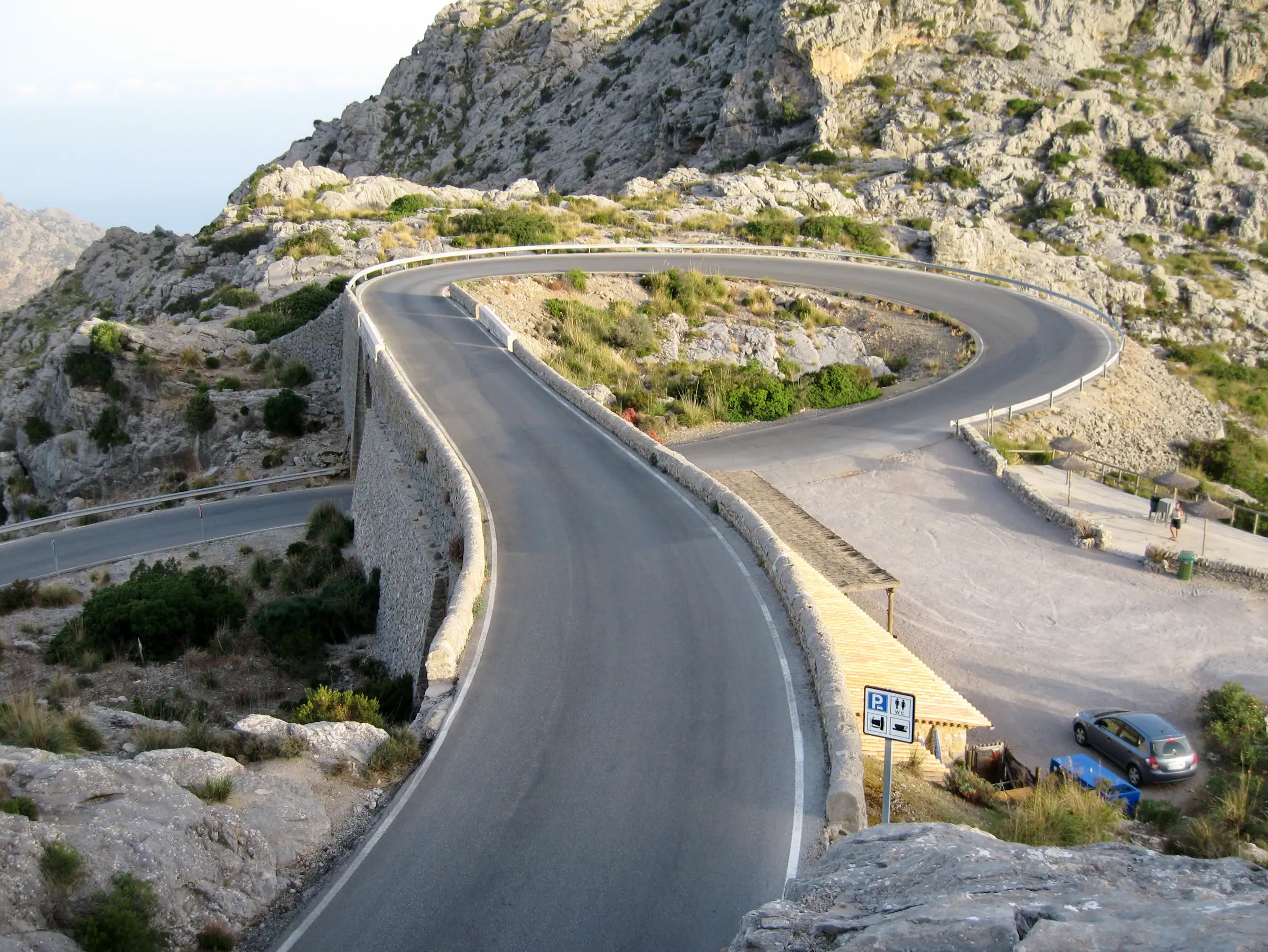
The Sa Calobra road, the MA-2141, winds down to the sea through 13 kilometres of hairpins clinging to the Serra de Tramuntana. It leads to Sa Calobra and the Torrent de Pareis, and it has a fearsome reputation.
On forums you’ll read everything and its opposite. Some drivers call it a pleasant drive; others describe a traumatic experience, stuck at the edge of a drop, unable to reverse. The truth lies in between. The road isn’t dangerous by design (the tarmac is as smooth as a snooker table); it’s dangerous because of the human factor: stress, misjudging the size of your car and, above all, the traffic. Here’s how to drive it down and back up without burning out your clutch or your nerves.
Sa Calobra road (MA-2141) in figures: what to expect
Before you turn the key, look at the numbers. The road drops from the Coll dels Reis, at 682 metres, to sea level. The average gradient is close to 7%, with much steeper sections.
The road is 6 metres wide on average. Do the maths: a standard hire car is about 1.80 metres wide, a tour coach 2.55 metres. 1.80 + 2.55 = 4.35 metres. On paper it fits, with more than 1.50 metres to spare. The problem is that this margin disappears on the 12 hairpin bends (180 degrees) and above all on the famous 270-degree bend, the “Nus de sa Corbata”. On these curves, coaches need the full width of the road to turn. Be in the wrong place at the wrong time and everything grinds to a halt.
Coaches: the one rule that matters
Get the coach timetable right and you remove 90% of the danger. Tour coaches work like a tide: they bring groups down in the morning and take them back up in the afternoon.
Times to avoid:
- 10.30am to 12.30pm (going down): dozens of coaches head down to the beach. Drive down then and you’ll be stuck in a slow convoy. Drive up then and you’ll have to reverse round hairpins in front of 12-tonne monsters.
- 3.30pm to 5.30pm (going up): the groups leave. The road is jammed in the uphill direction.
The golden slot: aim to reach the top of the road before 9.30am. You’ll have it almost to yourself, meet few vehicles and be able to enjoy the scenery while staying in your lane. For the return, either drive back up early (before 2pm) or wait until after 6pm for the golden light on the limestone (and see the best time to visit Mallorca).
How to drive the Sa Calobra road without wrecking your car
This long descent puts heavy strain on the brakes.
1. Use engine braking (essential)
Many drivers keep a tense foot on the brake pedal all the way down. That’s a serious mistake. The brakes overheat, the fluid boils (known as brake fade) and the pedal goes soft: you can lose all braking power. Drop into second gear, even first on the hairpins. Let the engine hold the car back. Only touch the brake to scrub off speed before a bend.
2. Look far ahead
Don’t stare at your bonnet. Your eyes should be two or three bends further down. If you spot the white roof of a coach coming up, look for a passing place straight away and wait for it. Never commit to a narrow section unless you’re sure you’ll get through.
3. Mind your mirrors
When you pass a wide vehicle, the bodywork often clears but the mirrors touch. Don’t hesitate to fold in your right-hand mirror (on the rock or wall side) if it’s tight.
The famous “Tie Knot” (Nus de sa Corbata)
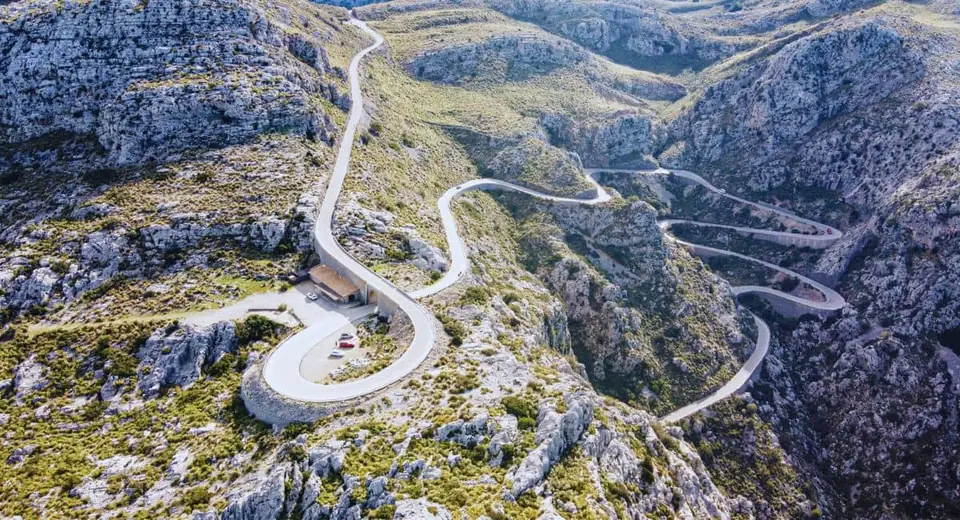
It’s the image you see all over Instagram. The engineer Antonio Parietti designed a bend where the road loops under itself to gain height. Ironically, it’s the easiest part of the drive: the road is wide there, visibility is perfect and the curve is gentle. It’s a moment to breathe. The real challenge is elsewhere: on the tighter hairpins, where you meet the coaches.
Cyclists: the silent danger
Mallorca is the mecca of European cycling, and on Sa Calobra you’ll never be alone. Hundreds of bikes ride up and down every day. On the descent, they often go faster than cars (up to 60 to 70 km/h), so check your mirrors before pulling over to the right. On the climb, they’re suffering and may swerve. Be patient and never overtake without perfect visibility. Saving 30 seconds is never worth putting a cyclist at risk.
Which car to hire for the Sa Calobra road?
A big SUV such as a BMW X5, or a 4×4, is a handicap: you’ll be wide, heavy and less nimble. The ideal car for Sa Calobra is a compact city car (a Fiat 500, Peugeot 208 or VW Polo) with a bit of power: avoid the weakest engines if there are four of you, or you’ll climb in first gear. The narrower you are, the more room you have when passing.
The alternative for nervous drivers: the Sa Calobra boat
If this has given you sweaty palms, don’t force it. The goal is to see the Torrent de Pareis, the spectacular mouth where the canyon meets the sea; the road is just a way to get there. There’s a far more relaxing option: the boat. From Port de Sóller, boats run several times a day. The one-hour crossing follows the inaccessible cliffs of the north coast. It’s grand, it’s cool, and it takes no driving at all. You land right on the pebble beach.
Is Sa Calobra worth it?
Yes. It’s one of the island’s landmarks. The grey, jagged karst landscape looks like nothing else in the Mediterranean. Once at the bottom, walk through the pedestrian tunnels to come out in the canyon of the Torrent de Pareis, where the acoustics are remarkable. Stick to the coach rules and use engine braking, and it will be one of the best memories of your trip. Go at midday in August in a big 4×4 and it will be your worst nightmare.
FAQ
When is the best time to drive the Sa Calobra road?
Reach the top of the road before 9.30am. For the return, drive back up before 2pm or after 6pm, avoiding 3.30pm to 5.30pm, when the coaches leave.
Is the Sa Calobra road dangerous?
Not by design: the surface is good and the road averages 6 metres wide. The risk comes from meeting coaches on the hairpins and from overheated brakes. Avoid the coach rush hours and use engine braking.
Which car should you hire for Sa Calobra?
A compact city car such as a Fiat 500, Peugeot 208 or VW Polo, with an engine that isn’t too weak if there are four of you. A big SUV or 4×4 is a handicap when passing other vehicles.
Can you get to Sa Calobra without a car?
Yes, by boat from Port de Sóller: boats leave several times a day and the crossing takes about an hour along the north coast.
Read next
The best beaches in Mallorca: top 10, coves and the wind rule
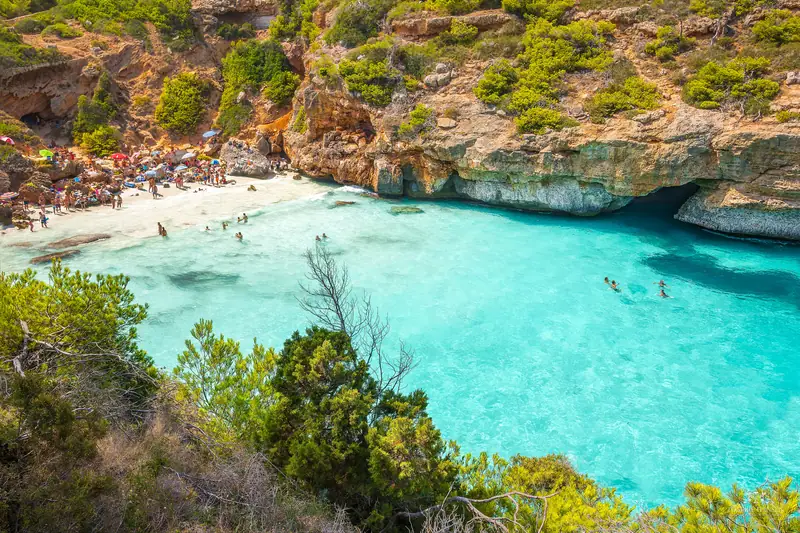
The best beaches in Mallorca: Es Trenc, Caló des Moro, Cala Pi, Playa de Muro. Access, parking, the wind rule and tips to beat…
Es Trenc beach, Mallorca: parking, access and how to avoid the crowds
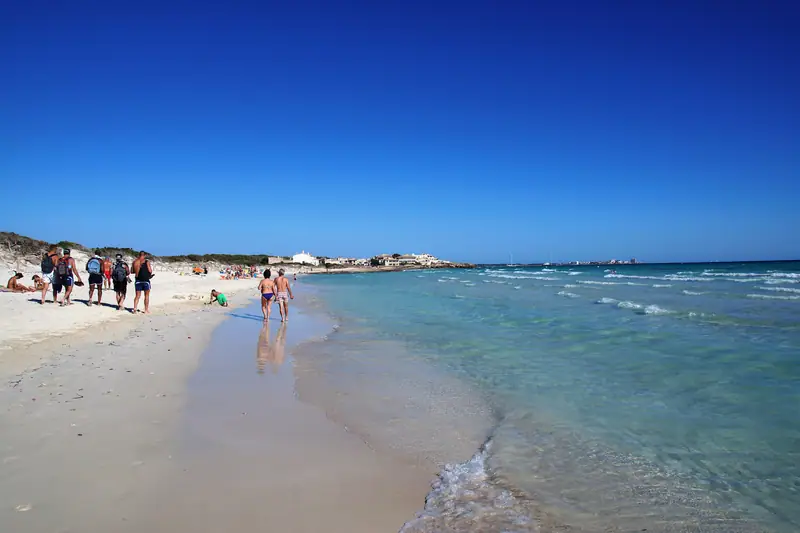
Over two kilometres of white sand with no concrete: where to park at Es Trenc (€8 to €10 a day), how to avoid crowds and seaweed…
Caló des Moro: parking, access and the best time to go
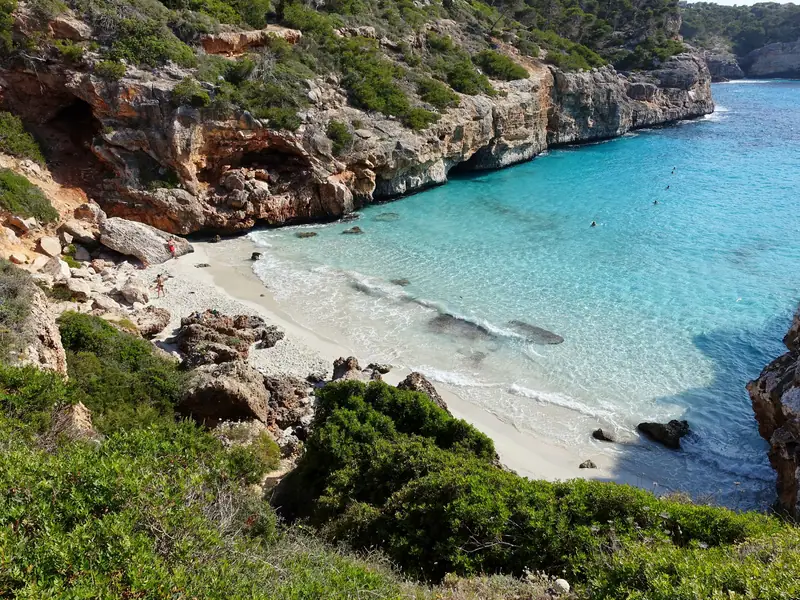
Caló des Moro parking explained: the free visitor car park, a 25 to 30-minute walk, and why to arrive before 8am.