GR221 in Mallorca: the 9 stages of the Dry Stone Route, refuges and tips for beginners
8 min readUpdated  By Antoon
Contents
- GR221 Mallorca stages: which one to start with?
- The GR221 stage by stage: what nobody tells you
- Best time for hiking in Mallorca on the GR221: avoid July and August on the ridges
- GR221 refuges: book well before you go
- GR221 kit: what makes the difference
- Three mistakes beginners make every year on the GR221
- GR221 budget for 7 days
- Dry Stone Route variants and extensions
- FAQ
The GR221 in Mallorca, the Ruta de Pedra en Sec or Dry Stone Route, crosses the Serra de Tramuntana from end to end: about 150 km on the main route, more than 260 km with the variants. It runs through a mountain range listed by UNESCO in 2011 as a cultural landscape, and it’s the island’s most emblematic trail. Deià to Sóller, one of the shortest stages in the Tramuntana, is often the first one people walk: you reach Sóller in time for lunch, tired but happy.
Despite what hiking forums suggest, the GR221 isn’t reserved for ultra-runners. Half of the stages are within reach of walkers in good shape, with no particular mountain experience. What follows is what really matters: where to start, how to book the refuges before they fill up, and the three mistakes beginners make again and again.
GR221 Mallorca stages: which one to start with?
The main GR221 route covers about 150 km in 9 official stages. The difficulty varies enormously: some take 3 hours, others more than 8 hours of walking and over 1,000 m of ascent. Our firm advice: if you’re a beginner, walk the Deià to Sóller section (official stage 5, from the Can Boi refuge to Muleta). That’s 9.9 km and 362 m of ascent, with sea views from the pass and no technical sections. You’ll be in Sóller for lunch.
| Stage | Start → Finish | Distance | Ascent | Level and verdict |
|---|---|---|---|---|
| 1 | Port d’Andratx → Sant Elm | 9.8 km | 372 m | Easy, along the coast |
| 2 | Sant Elm → Estellencs | 24.7 km | 1,010 m | Hard: cliffs, exposed sections |
| 3 | Estellencs → Esporles | 14.4 km | 670 m | Moderate, Banyalbufar terraces |
| 4 | Esporles → Deià | 23.1 km | 1,326 m | Hard, via Valldemossa, few people |
| 5 | Deià → Port de Sóller | 9.9 km | 362 m | Our pick for beginners |
| 6 | Port de Sóller → Tossals Verds | 27.8 km | 1,111 m | Hard: never alone the first time |
| 7 | Tossals Verds → Lluc | 15.1 km | 869 m | Moderate, high point above 1,200 m |
| 8 | Lluc → Pollença | 17.4 km | 189 m | Moderate, beautiful, underrated |
| 9 | Pollença → Port de Pollença | 6.7 km | 2 m | Easy, finish by the sea |
The GR221 stage by stage: what nobody tells you
The start of the route (stage 1, Port d’Andratx → Sant Elm, 9.8 km, then stage 2, Sant Elm → Estellencs, 24.7 km and 1,010 m of ascent) is often underestimated. Don’t be fooled: the gradients are steep, the cliff sections are exposed, and the seaside start gives the false impression of a stroll. Only begin here if you’re used to technical paths.
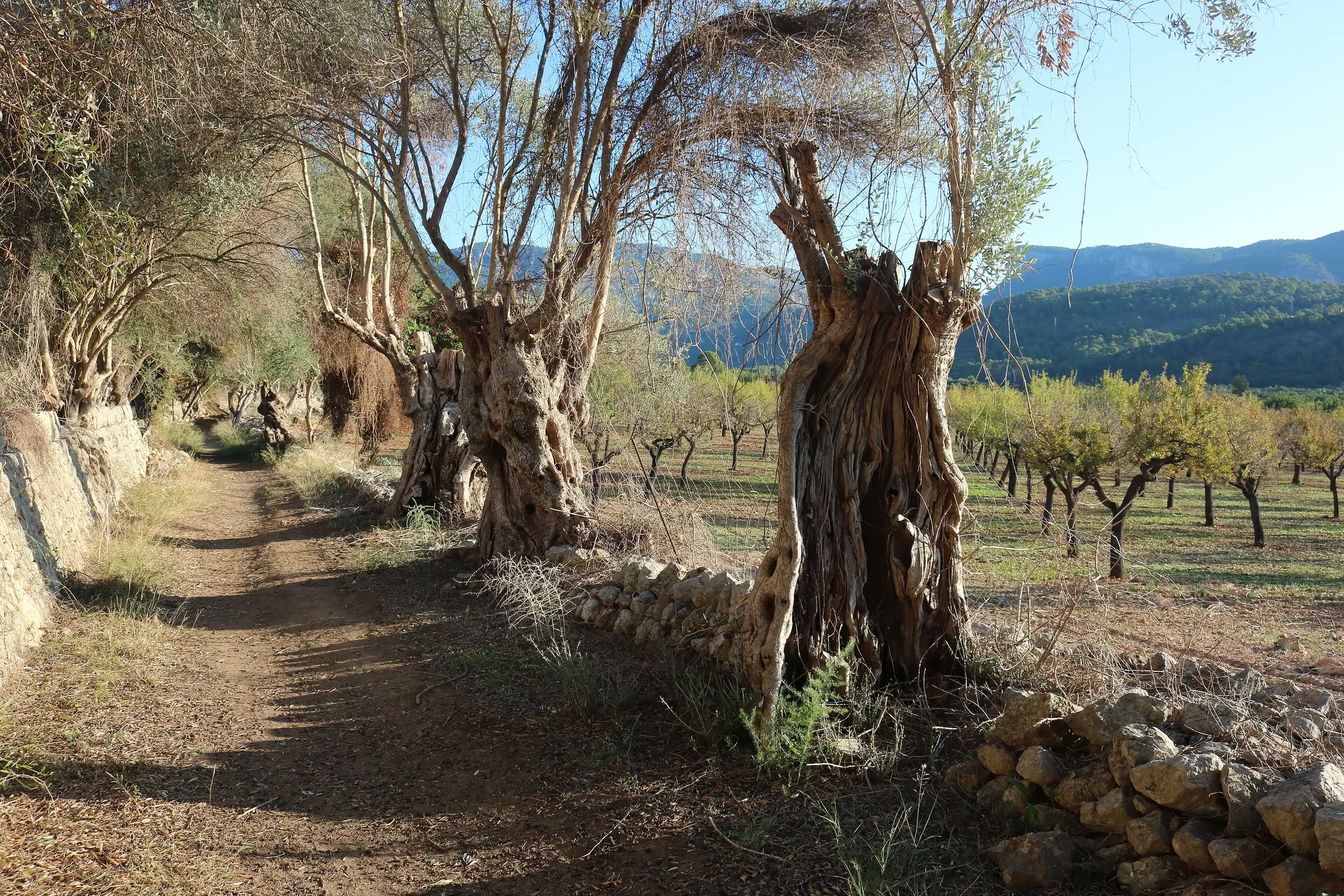
Stage 4 (Esporles → Deià via Valldemossa, 23.1 km and 1,326 m of ascent) is the most isolated on the route. Few people, plenty of centuries-old olive trees, and no reliable bar or fountain halfway. It’s the closest to what a Tramuntana path should be: wild, silent, with the sea in the background between the ridges. If you can only walk one stage on your own, make it this one.
Sóller → Lluc is in a league of its own: 43 km and nearly 2,000 m of ascent. The official route splits it into two stages (6, Muleta to Tossals Verds, then 7, Tossals Verds to Son Amer, near Lluc), with a night at the Tossals Verds refuge. Don’t try it in one go on your first GR221, however fit you are.
Stage 8 (Lluc → Pollença, 17.4 km) is the most underrated. It’s often walked last, on tired legs, yet it offers views over the central plain that no other stage has. Finishing in Pollença, with its medieval lanes and sunny cafés, is a fine way to end the trek. To explore the town afterwards, our guide to Pollença has the addresses.
Best time for hiking in Mallorca on the GR221: avoid July and August on the ridges
March to April and October to November, without hesitation. In March the almond trees are still in blossom on the lower parts of the route, temperatures range between 13 and 20°C, and the refuges aren’t full. In October the low autumn light shows off the ridges. If you’re still deciding when to come, our guide to the weather in Mallorca covers the Tramuntana’s particular climate.
In July and August, the longest and most exposed stages become genuinely dangerous: intense heat, high fire risk and south-facing sections with no shade. Heatstroke is a real risk in the Tramuntana in summer. In that season, stick to short stages such as Deià → Sóller (stage 5), setting off at 7am.
GR221 refuges: book well before you go
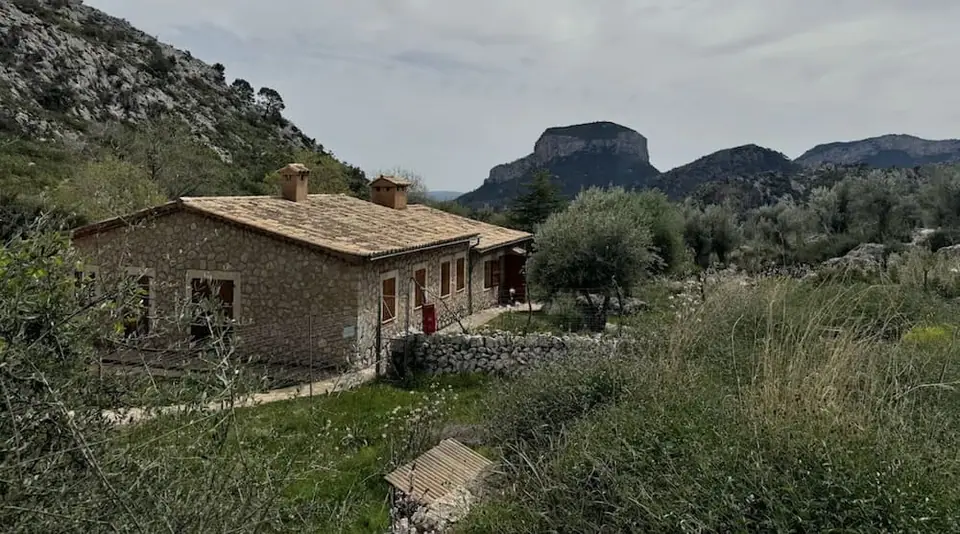
The Consell de Mallorca runs a network of eight refuges, five of them on the main GR221 route (Can Boi, Muleta, Tossals Verds, Son Amer and Pont Romà). A dormitory bed costs €14 a night (€9 up to age 16) and dinner €9.50. You book online on the portal of the Xarxa de Refugis del Consell de Mallorca, from 5 days to 4 months ahead. In April and October, the most popular refuges, such as Tossals Verds, are often full several weeks in advance.
If you can’t get a refuge bed, Deià, Valldemossa and Sóller have guesthouses (€60–120 a night) to break up the route. For Sóller, our guide to the Sóller train is useful if you’re arriving from or heading back to Palma at that stage.
GR221 kit: what makes the difference
Boots. In trainers, the risk of a sprained ankle on the Tramuntana’s uneven stones is high. Ankle-high hiking boots are a must. The Salomon X Ultra 4 GTX is the most common choice among locals, but any mid-cut boot with a Vibram sole will do. Avoid brand-new pairs you haven’t broken in: blisters on the technical descents of the Tramuntana are particularly painful.
Water. Two litres minimum per stage, three for the long ones (2, 4, 6 and 7). Fountains appear on the map, but several run dry in summer. Don’t count on refilling halfway. A water filter such as a Sawyer or LifeStraw lets you drink safely from natural springs if you’re out for several days.
GPS app. Download the GR221 Mallorca track on Wikiloc in offline mode before you set off. The orange-and-white waymarking is generally good but disappears on some sections after rain. OruxMaps with the IGN topographic map of the Tramuntana is the choice of seasoned mountain walkers. For getting around before and after the trek, our guide to TIB buses in Mallorca covers the lines serving the GR221’s start and finish points.
Three mistakes beginners make every year on the GR221
Mistake 1: trying to walk from Sóller to Lluc in one go. That’s 43 km and nearly 2,000 m of ascent: the Consell splits it into two stages (6 and 7), with a night at Tossals Verds. Walkers who attempt it end up turning back at 4pm, exhausted, out of water, still 15 km from the finish. This section isn’t for beginners.
Mistake 2: ignoring bus times. TIB buses link Sóller, Valldemossa, Deià and Pollença with Palma, but services drop to one or two a day out of season. Check tib.org the day before. A missed connection can leave you stranded at the pass as night falls.
Mistake 3: setting off without a paper map. A 1:25,000 map of the Tramuntana costs €10 and weighs nothing. It saves you if your electronics fail in the gorges, and your phone battery drains faster than expected in active GPS mode in the heat.
GR221 budget for 7 days
Allow €250 to €320 all in for 7 days: refuge nights (€14 each), dinners (€9.50), packed lunches and the bus to and from Palma. It’s one of the cheapest of Europe’s great treks for this level of beauty. If you add guesthouse nights in Deià or Valldemossa, budget an extra €100–150 per night.
Dry Stone Route variants and extensions
The official GR221 doesn’t cover everything the Tramuntana has to offer. Two connecting paths are worth knowing about before you go.
The Serra de Tramuntana path (the former name of part of the GR221) is waymarked in red and white. It’s older than the current GR221 and sometimes follows different tracks on stages 3 and 4. The two routes cross regularly, so check your map to avoid ending up on the wrong waymarks.
The link to Lluc Monastery from stage 7 takes you to the sanctuary of Lluc, one of the most important sites in Mallorca, where the monastery complex has guest rooms. Our guide to Lluc Monastery covers the sanctuary and the Blauets, its boys’ choir. Spending a night at Lluc in the middle of the GR221 is one of the most unusual experiences the island has to offer.
FAQ
Do you have to pay to walk the GR221?
No. The trail is completely free. Only the refuges and the meals you eat there cost money.
Can you walk the GR221 with children?
Deià → Sóller (stage 5) and the Valldemossa → Deià part of stage 4 are doable with fit children aged 10 and over. Avoid Sant Elm → Estellencs (stage 2) and Sóller → Lluc (stages 6 and 7) with under-14s. With young children, the area around Sóller and its vintage train is a good alternative.
Can you walk the GR221 without booking refuges?
The refuge rules let you turn up on the day, but only if beds are left: in April, May and October, don’t count on it. Bookings open from 5 days to 4 months ahead. Reaching a full refuge after a long stage is a situation to avoid at all costs.
How many days do you need for the whole GR221?
Seven to nine days for the 9 official stages. Most walkers do 4 or 5 stages, choosing the most accessible and skipping the longest (2, 4 and 6).
Can you hike the GR221 solo?
Yes, for most stages. Sant Elm → Estellencs (stage 2, exposed cliff sections) and Sóller → Lluc (stages 6 and 7, length, isolation) aren’t recommended solo without mountain experience. Always tell someone your route and expected arrival time before heading out alone.
Book onlineThe most populartours
Book online before you go: you pick the time slot, and most tours can be cancelled for free up to 24 hours before.
 At sea
Mallorca boat trip
Compare tours, times and traveller reviews.
See prices →Free cancellation on most Guided tour
Serra de Tramuntana tour
Compare tours, times and traveller reviews.
See prices →Free cancellation on most Day trip
Caves of Drach
Compare tours, times and traveller reviews.
See prices →Free cancellation on most
Read next
Getting around Mallorca: buses, trains, taxis, car hire and ferries
Getting around Mallorca: A1 airport bus, TIB and EMT buses paid by card, Sóller train and metro, taxi fares, car hire, parking in…
Mallorca weather by month: the best time to visit, sea temperature and prices
The best time to visit Mallorca is June or September: 28°C, a 21-25°C sea, fewer crowds. Mallorca weather by month (AEMET…
Mallorca in winter: temperatures, what’s open and a month-by-month verdict
Is Mallorca in winter worth it? October to February month by month: temperatures, sea, rain, what closes, almond blossom and how…