Port de Sóller, Mallorca: things to do, the tram, beaches, lighthouses and where to stay
12 min readUpdated  By Antoon
Photo: Vicenç Salvador Torres Guerola, CC BY-SA 3.0, via Wikimedia Commons
Contents
- Arriving in Port de Sóller by tram
- The Sóller tram to Port de Sóller: stops, journey time and fares
- Things to do in Port de Sóller
- Boat trips from Port de Sóller to Sa Calobra
- The bay of Port de Sóller, between two lighthouses
- Hiking from Port de Sóller: Muleta, Torre Picada and the GR 221
- A day in Port de Sóller
- Port de Sóller through the seasons
- Getting to Port de Sóller by bus, car or train and tram
- Where to stay: Port de Sóller or Sóller
- Is Port de Sóller right for you?
- FAQ
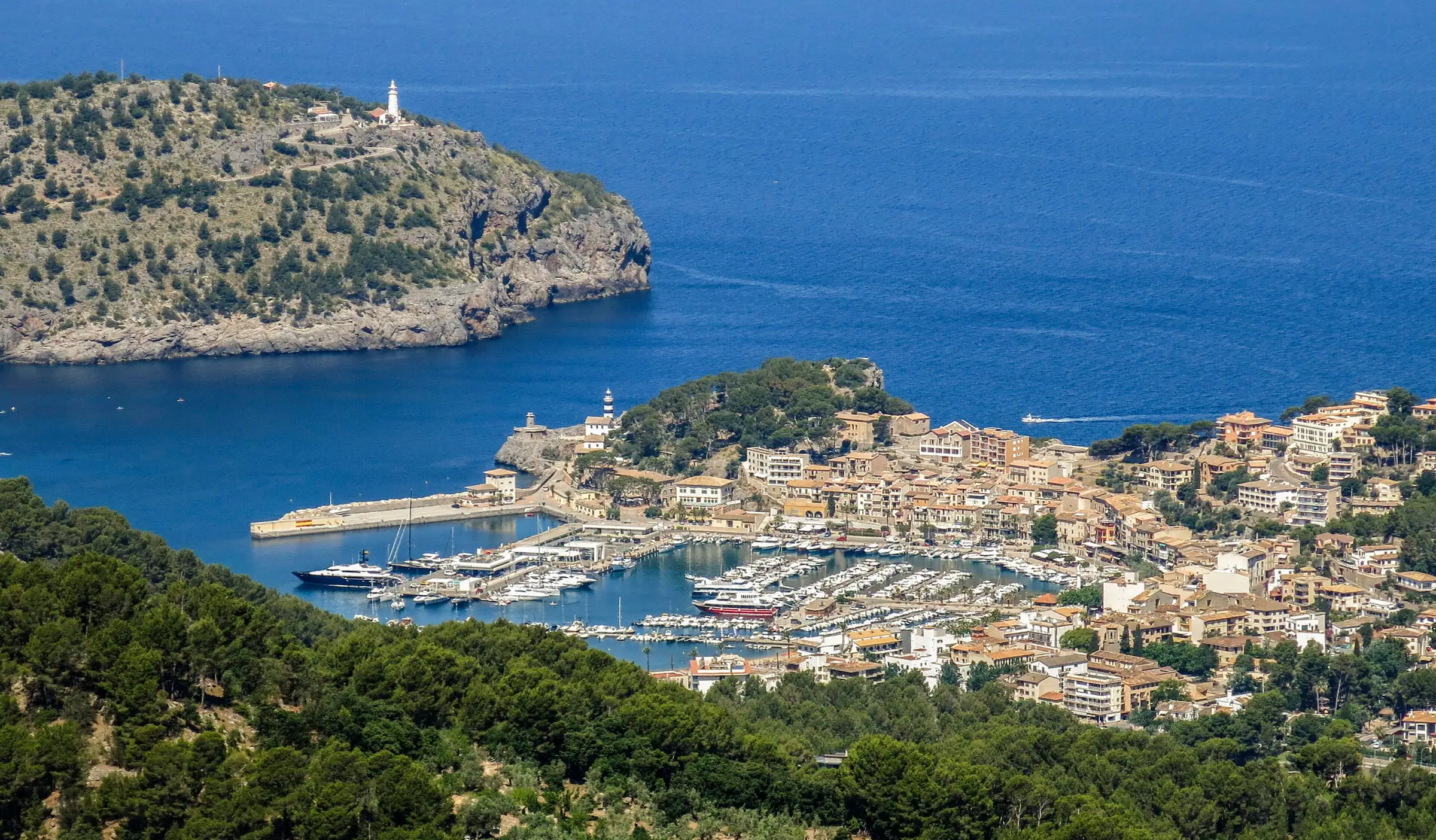
Port de Sóller is the harbour of Sóller, on the north-west coast of Mallorca, 27 km from Palma. It wraps around an almost enclosed bay guarded by two lighthouses, Cap Gros and sa Creu. The best things to do in Port de Sóller all start from the tram terminus: the 1913 tram ride from Sóller, the fishermen’s quarter of Santa Catalina, three sandy beaches, the walk to the Cap Gros lighthouse at sunset and, from April to October, the boat to Sa Calobra. The port has 2,485 inhabitants and belongs to the municipality of Sóller, which has 13,882.
Arriving in Port de Sóller by tram
After Plaça de Sa Torre, the tram leaves the road and glides along the pedestrian promenade of Es Través, with the bay on your left. The wooden cars move at walking pace between the café terraces and the sand. Ahead, two headlands close the harbour: the black-and-white striped sa Creu lighthouse to the north, and the Cap Gros lighthouse, 120 m above the sea, on the western cliff.
The terminus is in front of Mar i Sol, the old tram station, which became a restaurant on 5 May 1929. During the Spanish Civil War it housed the officers of the Italian submarines moored at the base. Behind it begin the marina pontoons, where llaüts, traditional wooden fishing boats, sit alongside yachts.
Above the quays climbs the fishermen’s quarter of Santa Catalina: narrow lanes, tightly packed houses, stepped ramps. Down below are the fishing quay and the fish market. At the top, 5 minutes on foot from the terminus, the old oratory of Santa Catalina has housed the Museu de la Mar since 24 August 2004, and its clifftop terrace faces the sunset.
Don’t confuse the two Sóllers. The town, with the church of Sant Bartomeu and Plaça de la Constitució, is 4 km inland: see our guide to Sóller. Bus 204 links the two in 10 minutes.
The Sóller tram to Port de Sóller: stops, journey time and fares
On 4 October 1913, Mallorca’s first electric tram line opened between Sóller and its port, on 4,868 m of track. The journey takes half an hour. The operator, the Ferrocarril de Sóller, publishes one departure an hour from Sóller between 8am and 7pm, and from the port between 8.30am and 7.30pm, for the current season. A one-way ticket costs €10, paid on board; the combined train and tram ticket from Palma costs €40 return. From 23 November to 22 December 2026, a bus replaces the tram. For the train and its timetable, see our page on the Sóller train.
- Plaça d’Espanya, outside Sóller station. The first stop is under a plane tree, opposite the station for the train from Palma. Cars 1 to 3 date from 1913; cars 20 to 24 came from the Lisbon tramways. Departures leave on the hour.
- Es Born and Plaça de la Constitució. The tram runs down Es Born, with the church of Sant Bartomeu on the right, then crosses Plaça de la Constitució between the town hall and the Banc de Sóller. The Avinguda Cristòfol Colom stop serves the municipal market.
- L’Horta and the iron bridge. Between orange and lemon groves, the tram crosses the Torrent Major on an iron bridge. At L’Horta, two stops are request stops only: pull the strap that rings the bell.
- The monument of 11 May 1561. The rails cross the port road at the monument to the heroes of 1561, who drove back the corsairs who had come to plunder Sóller.
- Sa Roca Rotja. The track doubles in open country, where the tram sometimes waits for the one heading back up to Sóller.
- Plaça de Sa Torre. Get off here for Repic beach and for the walk to the Cap Gros lighthouse, 25 minutes along the water.
- Es Través and the Mar i Sol terminus (4.9 km). The last stretch follows the bay along the Es Través promenade. In summer, the jardineres, open cars bought from the Palma tramways in 1954, are coupled on.
Things to do in Port de Sóller
Everything is on foot from the tram terminus: Santa Catalina and the sa Creu lighthouse to the north, the beaches to the south, Cap Gros and the Torre Picada at either end of the bay.
Santa Catalina and the Museu de la Mar
The oratory overlooks the fishermen’s quarter; corsairs destroyed it in 1542. It now houses the Museu de la Mar, a branch of the Museu Marítim de Mallorca, with models, fishing gear, photographs and recorded memories of former fishermen. The terrace next door, on the cliff, faces the sunset. It is 5 minutes on foot from the terminus; ask at the tourist office in the port for the museum’s opening hours.
The sa Creu lighthouse
The first lighthouse was lit on 15 September 1864, near a bufador, a blowhole where waves shot up 30 m in storms from the north-west. The present black-and-white striped tower, 13 m high, dates from 30 May 1945. It is 6 minutes on foot from the terminus.
Port de Sóller beaches
The port has three sandy beaches. Repic beach (Platja d’en Repic) lines the south of the bay, at the Sa Torre tram stop or 13 minutes on foot from the terminus, with a pay car park. The Torrent Major separates it from Través beach, linked by the Pont d’en Bajoca; on the day of the Firó, the battle against the “Moros” is fought here. Can Generós beach borders the promenade near the terminus, 5 minutes on foot, with the tram passing a few metres away.
The Cap Gros lighthouse and the Muleta refuge
The tower, built by the town council in 1842, was not lit until 20 February 1859. Its light stands 120 m above the sea and reaches 19 nautical miles. Next to it, the Muleta refuge occupies the former military radio-telegraph station (1912-1956). It is 2 km and 25 minutes on foot from Sa Torre; the lighthouse road is narrow. The esplanade faces west, which makes it the place for sunset.
The Torre Picada
This round watchtower guards the harbour entrance from the north-eastern cliff, part of the line of towers built after the corsair attacks of 1542 and 1561. From its foot, the view runs along the north coast to the islet of s’Illeta. It is 2.3 km and 30 minutes on foot from the terminus; there is no open access to the inside.
The harbour, the llaüts and the boat quay
From the pontoons to the fishing quay, the promenade passes the llaüts and the fish market. The Barcos Azules boats to Sa Calobra, Cala Tuent and, on request, Sa Foradada leave from here.
Boat trips from Port de Sóller to Sa Calobra
No road follows the coast to Sa Calobra: the boat runs along the cliffs in an hour, from 1 April to 31 October, at 9.50am, 11.20am, 1pm and 3pm. From Sa Calobra, a path and tunnels lead to the mouth of the Torrent de Pareis. Cala Tuent is 50 minutes away. A return ticket costs €35 for adults (€23 one way) and €18 for children aged 6 to 11, with 10% off online; bookings on 971 63 01 70. There are no sailings from 22 November 2026 to 31 January 2027. For all boat trips, see our page on boat trips in Mallorca; to go by road, read our guide to the Sa Calobra road.
The bay of Port de Sóller, between two lighthouses
The bay opens to the north-west between two cliffs: Cap Gros to the west, the sa Creu headland and Santa Catalina to the north. Inside, the shore draws a horseshoe from Repic beach to the quays. To see it in full, climb to Cap Gros or the Torre Picada.
The tram used to carry crates of oranges down to the port for shipment to French harbours, took fish up to Sóller market in an insulated wagon and delivered coal to the navy’s submarine base. The old powder magazines can still be seen above the port, on the Camí dels Cingles. The fishing hamlet has become the main tourist centre of the valley, but the fishing quay and the fish market still work at the foot of Santa Catalina.
Hiking from Port de Sóller: Muleta, Torre Picada and the GR 221
The Camí de Muleta, waymarked by the Balearic government, starts on the Ma-10 between Sóller and Deià (kilometre point 56.950) and drops to the port or Repic beach: 4.8 km, 1 hour 15 minutes, difficulty 1 out of 5. It crosses the Cas Avinyons olive grove, home to the olive tree called the Camell (the camel), then Muleta de Ca s’Hereu, an agroturismo whose olive press can be visited.
The Consell de Mallorca suggests a family route via Santa Catalina and the Torre Picada: 4.8 km, 1 hour 40 minutes and 174 m of climbing.
The GR 221 stops at the Muleta refuge, 110 m from the Cap Gros lighthouse: 30 places, €14 a night in a dormitory (€9 up to age 16), booking required. The previous stage starts at Can Boi in Deià, the next leads to Tossals Verds. See our guides to hiking in Mallorca and the GR 221 for beginners.
A day in Port de Sóller
Any day from April to October, when the Sa Calobra boats sail daily.
- 9am: the tram from Plaça d’Espanya in Sóller, arriving at the terminus at 9.30am, €10 ticket on board.
- 9.50am: the boat to Sa Calobra, an hour at sea below the Tramuntana; back at 1.40pm, €35 return.
- 2.45pm: lunch on the harbour, where the restaurants run from the terminus to the fishing quay.
- 4.30pm: Santa Catalina, the oratory and the Museu de la Mar, then the sa Creu lighthouse, 6 minutes from the terminus.
- 5.30pm: a swim at Repic beach.
- 7pm: sunset at Cap Gros, 2 km and 25 minutes on foot from Sa Torre.
- 9pm: back on bus 204, which reaches Palma in 45 minutes (the last tram leaves at 7.30pm).
Port de Sóller through the seasons
- Spring: the Sa Calobra boats sail daily again from 1 April, and bus 231 to Lluc and Pollença restarts on 27 March. The Firó falls on the Monday after the second Sunday in May (10 May in 2027): the “Moros” land in the port at around 3pm.
- Summer: the tram couples on its open cars and four boats a day leave for Sa Calobra. The blue zone is payable from 10am to 7pm, and from 7am to 10pm at the Carrer de Lepanto car park.
- Autumn: boats and bus 231 run until 31 October. Parking in the blue zone becomes free on 16 November.
- Winter: the train is suspended from 23 November 2026 to 1 February 2027, the tram until 22 December (replacement bus), the boats until 31 January. Bus 204 runs every 30 minutes, and the Muleta refuge stays open and heated.
The port market is on Thursdays from 8am to 2pm. Sóller’s market is held on Saturdays from 8am to 2pm around Plaça de la Constitució, 30 minutes away by tram.
Getting to Port de Sóller by bus, car or train and tram
By car, the port is 27 km from Palma, 33 minutes via the Ma-11 and the Sóller tunnel, toll-free since the end of 2017, then the sa Mola tunnel, about 1.3 km long. From the airport it is 36 km, 40 minutes. To hire a car, see our car hire page.
Parking: from 1 March to 15 November, the harbour car parks are blue zone from 10am to 7pm, the Carrer de Lepanto car park from 7am to 10pm (parking meter or the EasyPark app). From 16 November to the end of February, the harbour blue zone is free. Green zones are for residents only (€90 fine).
TIB bus 204 leaves from the Estació Intermodal, below Plaça d’Espanya in Palma, and reaches the port in 45 minutes, every 30 minutes in winter and every 20 to 35 minutes in summer. Bus 203 runs via Valldemossa and Deià, bus 232 links the port with Sóller and Fornalutx, and bus 231 links the port with Lluc, Pollença and Alcúdia four times a day from 27 March to 31 October, 1 hour 45 minutes to Port de Pollença. You pay by bank card on board: see our guide to TIB buses.
The historic route combines the 1912 train to Sóller (27 km, 13 tunnels, one hour) with the tram: €40 return. From the airport, take the A1 bus to Plaça d’Espanya (€5), then the 204. See our guide to Palma airport.
Where to stay: Port de Sóller or Sóller
The port has the big hotels, on the bay and on the hillsides. The town of Sóller, 30 minutes away by tram, has more townhouse hotels.
- Seafront, around the tram terminus: for a stay without a car and for boat trips. The Fergus Style Soller Beach is on Carrer de la Marina, near the terminus and the boat quay.
- Es Través and Repic beach: for families and swimming. The Eden is on the Passeig d’Es Través, Los Geranios on the Passeig de la Platja, both facing the beach and on the tram line.
- The heights north of the port: for views over the bay, with strong legs or a car, as the streets are steep. The five-star Jumeirah Port de Sóller is on Carrer de Bèlgica, on the cliff towards the Torre Picada; the Bikini is on Carrer de Migjorn, the Eden Nord on Carrer de Mestral.
- Sóller town: for the train to Palma and village life. The five-star Gran Hotel de Sóller is on Carrer de la Romaguera, Cal Bisbe on Carrer del Bisbe Nadal, a few minutes from the station and the tram.
Is Port de Sóller right for you?
It suits you if you travel without a car (bus 204 from Palma in 45 minutes all year, the tram from Sóller in 30), if you want to see the north coast from the sea, or if you like walking. It suits you less if you plan to drive around in summer, when the blue zone is payable, or if you want Sa Calobra by boat in December or January. Allow half a day for the port, Santa Catalina and the sa Creu lighthouse, a full day with the Sa Calobra boat, two days with Sóller, Cap Gros and the Torre Picada. The best time is April to June, with four boats a day, or the Firó in May.
FAQ
How far is Port de Sóller from Sóller?
4 km as the crow flies. The tram covers 4.9 km of track in 30 minutes, and bus 204 does the trip in 10 minutes.
How much is the tram from Sóller to Port de Sóller?
€10 one way, in either direction, paid on board. The combined train and tram ticket Palma – Port de Sóller – Palma costs €40.
Can you get from Palma to Port de Sóller by train?
Not directly: the train runs from Palma to Sóller in an hour, then the tram takes you down to the port. The train is suspended from 23 November 2026 to 1 February 2027; bus 204 runs all year.
How do you get from Palma airport to Port de Sóller?
Take the A1 bus to Plaça d’Espanya (€5), then TIB bus 204. By car, it is 36 km and 40 minutes.
How do you get to Sa Calobra from Port de Sóller?
By boat, from 1 April to 31 October: four departures a day, an hour at sea, €35 return for adults. There are no sailings from 22 November to 31 January.
Is the Sóller tunnel free?
Yes, it has been toll-free since the end of December 2017, when the Consell de Mallorca bought back the concession. The sa Mola tunnel, towards the port, is free too.
Read next
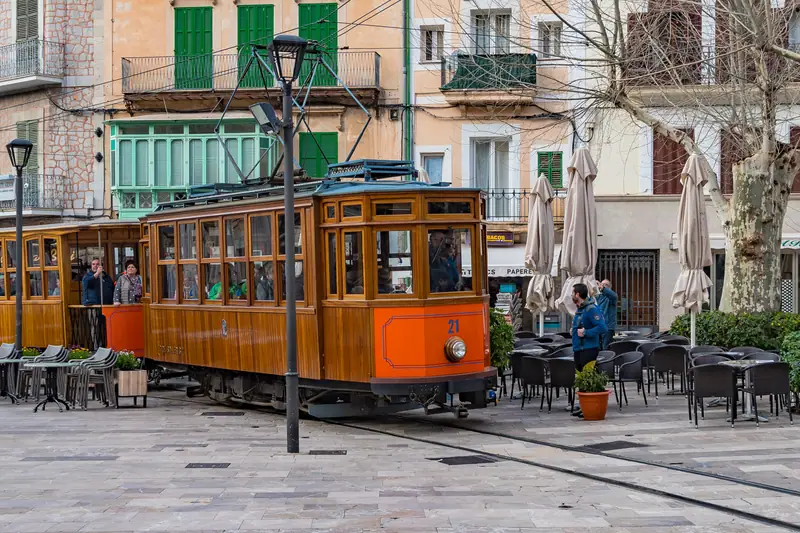
Things to do in Sóller, Mallorca: the train, the tram, the port and the valley
Things to do in Sóller, Mallorca: train or free tunnel, Sant Bartomeu church, the tram to the port, red prawns and where to park.
Valldemossa, Mallorca: the Charterhouse, coca de patata and parking
Valldemossa without the crowds: Chopin's Charterhouse (€12.50), coca de patata at Ca'n Molinas, the best viewpoint, the…
Deià, Mallorca: the artists’ village and Cala Deià (access, swimming, parking)
Deià, Mallorca: stone houses, Robert Graves' home, swimming at Cala Deià, how to get there from Palma, where to eat and where to…