Mallorca in winter: temperatures, what’s open and a month-by-month verdict
11 min readUpdated  By Antoon
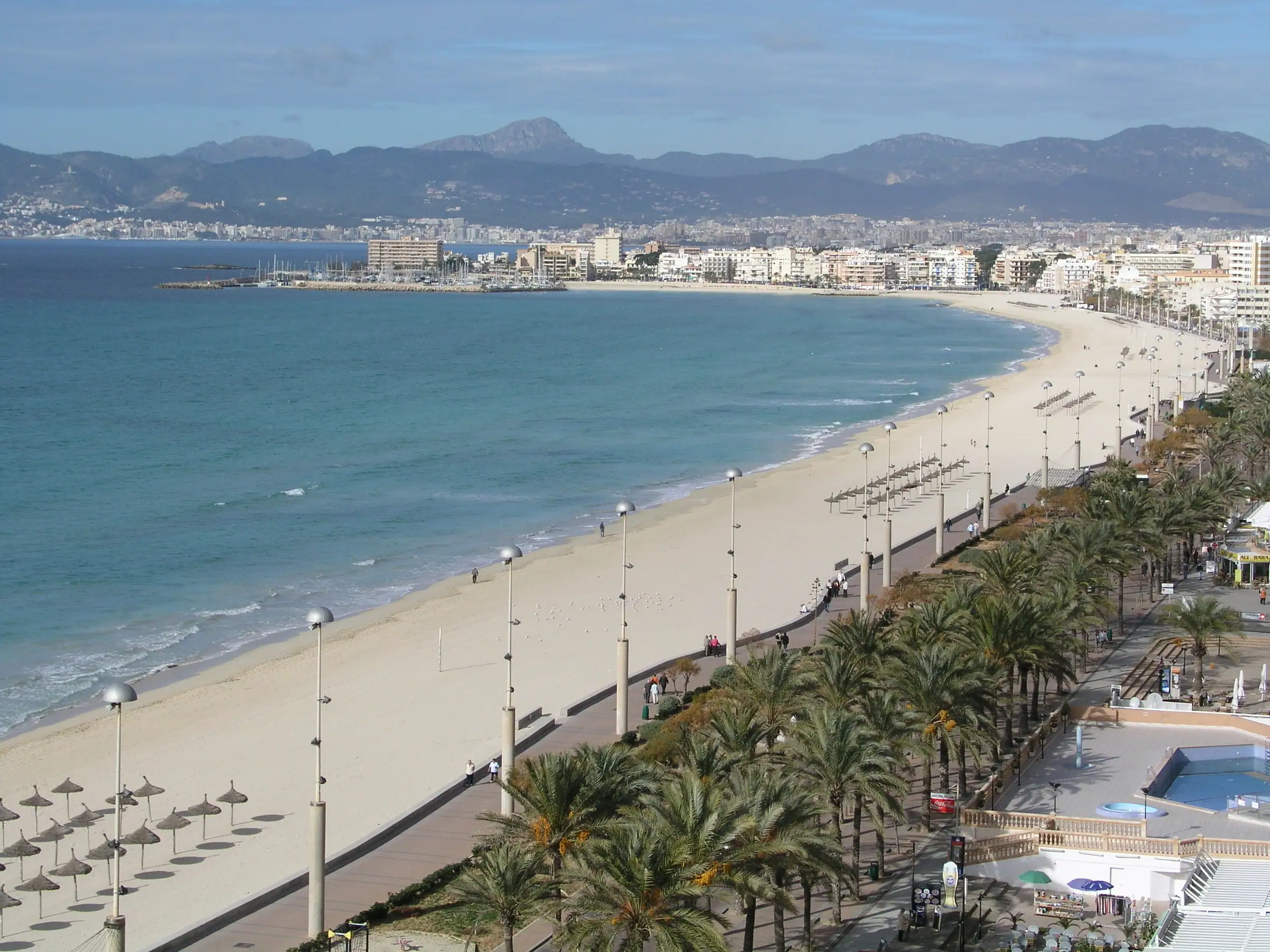
Photo: Otto Buchegger Max Sorglos on de.wikipedia, CC BY-SA 3.0, via Wikimedia Commons
Contents
- Mallorca in winter: the month-by-month verdict
- Mallorca in October: the last month when everything still works
- Mallorca in November: the worst month of the year
- Mallorca in December: the Palma city break that saves the winter
- Mallorca in January and February: dry, bright and quiet
- What’s actually closed in Mallorca from November to March
- How much a winter holiday in Mallorca costs: half the price of July
- What to pack for Mallorca in winter
- FAQ
A Sunday in mid-November, 11am, on the seafront promenade at Port d’Alcúdia: two restaurants open out of a row of twenty. The others had pulled down their shutters three weeks earlier, with no date given for reopening. A north wind was blowing at 40 km/h, the water was slapping against empty pontoons, and an Englishwoman in a fleece was looking for somewhere to get a coffee. She didn’t find one for another 500 metres.
That’s the picture nobody shows you when Mallorca in winter is sold as a no-brainer. Winter in Mallorca is real, but it doesn’t start in October and it doesn’t work everywhere. Depending on the month and the area, you’ll find an island that is still generous, or a dead beach resort where even buying a loaf of bread gets tricky.
This guide gives a straight verdict, month by month, on what works and what disappoints. October holds up, November is a trap, December is all about Palma, and January and February win you back with the almond blossom. Here’s the detail.
Mallorca in winter: the month-by-month verdict
The five months lumped together as “winter” are not equal at all. Some are warm shoulder months in disguise, others are genuine low-season months when the island goes into standby. This is the table worth having before a first off-season trip.
| Month | Air temp (min/max) | Rain | Sea temp | Verdict |
|---|---|---|---|---|
| October | 13 / 24°C | 62 mm | 22°C | Excellent |
| November | 8 / 19°C | 55 mm | 19°C | Best avoided |
| December | 5 / 16°C | 48 mm | 16°C | Fine, Palma only |
| January | 4 / 15°C | 37 mm | 14.5°C | Good, dry and bright |
| February | 4 / 15°C | 32 mm | 14°C | Very good (almond blossom) |
What the table doesn’t tell you, but which changes everything: the wettest month isn’t December or January. On paper it’s October, and in practice it’s November, because the showers last longer and are colder. In December and January it might rain on two days in the month, followed by a fortnight of sunshine. In November it rains three days in a row.
The sea temperature drops sharply between October and November: 22°C on average in October, 18.7°C in November. That is when the island tips from one season to the next: the month-by-month detail is on our page about when to go to Mallorca.
Mallorca in October: the last month when everything still works
October isn’t winter. It’s the best value-for-money window of the year, better than June or September. Temperatures hover around 23°C in the afternoon, the sea averages 22°C and, above all, everything is open: hotels, restaurants, shuttles, the beach clubs that want to stretch the season, and TIB buses running a full timetable.
Then there are the crowds, which simply evaporate. On a Wednesday in mid-October at 1pm, you can find the car park at Es Trenc half empty, when in July it’s full by 10am. The beach looks the way you picture it from home: a ribbon of white sand with five towels on it. For access and parking, see our Es Trenc guide.
October’s catch is the weather. The first fortnight feels like a fine summer; the second is more changeable. Late October brings the first heavy downpours, sometimes violent ones. If you’re travelling in the last week, have a cultural plan B in Palma for the rainy day you’re bound to get.
What closes on 1 November
Watch out for the administrative switch. Many hotels in Cala d’Or, Cala Millor, Port d’Alcúdia and Magaluf close their doors on the evening of 31 October, on the dot. If you go in early November expecting October to carry on, you’ll land on an island stacking away its chairs. October yes, November no: the cut-off really is that sharp.
Mallorca in November: the worst month of the year
It needs saying: November is the month to avoid. Not because it’s too cold, but because it’s the in-between month. Too late for the beach, too early for the almond blossom, with unpredictable weather that spoils one outing in two.
Picture a walk on the GR221 near Deià on a Tuesday in mid-November: you set off at 9am under a decent sky, a torrential downpour starts at 9.20am, you’re soaked by 9.35am and turning back at 9.40am. The path can become a stream in less than an hour. That’s exactly what makes November frustrating: it doesn’t rain that much in volume (55 mm on average), but when it rains, it pours, and for a long time.
On mountain roads, things can turn quickly. Tramuntana roads can close within a few hours when a big storm hits, and closures are often only announced in real time. A November storm is not an August storm: it calls out the fire brigade and empties the trails.
Add resorts that have already turned into ghost towns and beach clubs that have all shut, and you get the worst compromise of the year. The one case where November makes sense is a pure three-day weekend in Palma, focusing only on the city, its museums, tapas and the cathedral. For a proper week’s holiday, pick another month.
Mallorca in December: the Palma city break that saves the winter
December isn’t about the beach. It’s about Palma, and this is when the city becomes liveable again for a curious visitor. The café terraces of Santa Catalina get their regulars back, La Seu cathedral can be visited without queuing, and Mallorcans, who are crowded out of their own city centre in August, take it back.
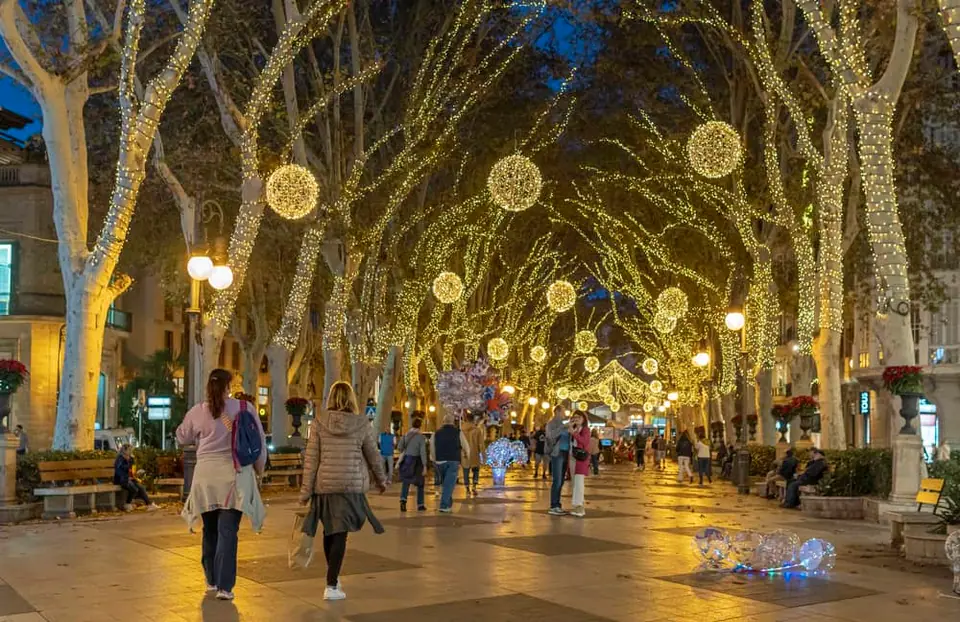
The Passeig del Born is lit up from late November until Epiphany, in early January. The illuminations put up by the city council are particularly well done. Plaça Major, the Rambla and the Parc de ses Estacions host the Fira de Nadal i Reis, the city council’s Christmas market (nativity figures, decorations), open every day from late November until Epiphany.
On the food front, prices come back down to earth. They’re far more reasonable than in summer, and at the morning market stalls you’ll finally find Mallorcans buying their fish for dinner rather than tourists photographing the market. It’s another Palma: much more local, much calmer.
A typical December day in Palma
Morning at the Olivar market for a coffee and a pastry, then the cathedral between 10am and 11am, a tapas lunch in a bodega in La Lonja, a stroll along the Passeig del Born and a stop at the Juan March Foundation. In the evening, dinner in Santa Catalina, then a walk back towards the port.
What December can’t do: the beach, long hikes, boat trips. If your idea of a holiday leaves out cities, December isn’t for you. If you like wandering round a European capital that has room to breathe, it’s an excellent bet.
Mallorca in January and February: dry, bright and quiet
Counter-intuitively, these two months beat November and December. The climate turns dry and bright: rainfall drops to 37 mm on average in January, far less than in autumn, and the sun shines for a little over five hours a day on average. January in Mallorca means a vivid blue sky, 15°C in the afternoon and crisp 4°C mornings that recall the dry north of Spain.
Almond blossom season
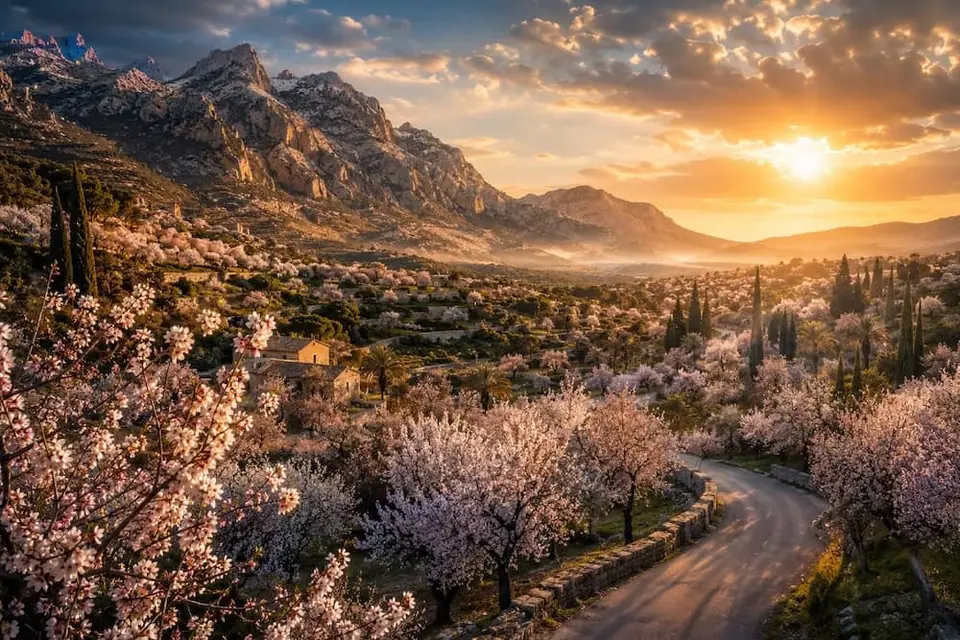
Late January sees the start of winter’s real event: the almond blossom. It covers a good part of February and sometimes spills into March. The blossom lasts only two to three weeks, and the different varieties open one or two weeks apart. The date shifts from year to year: in 2026 the first flowers appeared as early as 2 January; in 2025 the blossom arrived around 10 February. February remains the safest bet. All the detail is in our guide to almond blossom in Mallorca.
The best places to see what islanders call “Mallorcan snow”, the white carpet of blossom:
- The centre-west of the island, around Santa Maria del Camí, Bunyola, Consell and Marratxí; the Sóller train runs through fields in blossom
- The plateau around Son Servera, with the Fira de la Flor d’Ametler in early February on the Ca S’Hereu estate
- The Ma-2110 road, east of Alaró, towards Biniamar and Mancor de la Vall
- In Palma itself, Es Secar de la Real behind the monastery, and the orchards of Son Espanyol, visible from the ParcBit car park
- The countryside around Llucmajor and the road from Santa Ponça to Es Capdellà
- The Sóller valley, where almond trees share the land with orange groves
Another strong argument for January and February: it’s also the ideal window to tackle the stages of the GR221 without overheating. The Dry Stone Route offers its best walking conditions at this time of year, the refuges are open but not overcrowded, and the dry air keeps the sea views clear.
The only real risk in these two months is a short cold snap, when the thermometer can drop to 2°C at night, with a tramontana wind that makes it feel like -5°C. It’s rare and lasts three days at most, but it does happen. Pack a fleece, a windproof jacket and a light hat.
What’s actually closed in Mallorca from November to March
Winter in Mallorca isn’t “everything runs a bit slower”, it’s “half of it is shut”. A large share of resort hotels close for the winter, and that’s only part of the story, because it says nothing about the restaurants, scooter hire shops, diving schools and private airport transfers that close too.
The rule is simple: the more an area depends on summer tourism, the more of a ghost town it becomes in winter. These are the dead zones from November to March, where you’ll really struggle to find dinner on a weeknight:
- Magaluf and Peguera, two resorts geared to British and German visitors, almost entirely closed
- Cala d’Or, Cala Bona and Cala Millor, with perhaps 10 to 15% of businesses open
- Port d’Alcúdia and Can Picafort, eerily empty, with only a few local bars holding on
- S’Arenal and Playa de Palma (eastern part), where activity shrinks to a handful of hotels aimed at business travellers
The places that stay alive have a local population and a life of their own: central Palma (old town, Santa Catalina, Portixol), Sóller and its port, Valldemossa, Deià to some extent, Alcúdia old town (not the port), Pollença and Santanyí. These seven places hold most of what’s worth doing in winter, and Palma alone accounts for most of the island’s winter hotel beds.
Mallorca or Ibiza in winter?
Mallorca wins hands down. Ibiza shrinks to Ibiza Town and Santa Eulalia, and the rest is empty. Mallorca keeps a real local life outside its resorts.
How much a winter holiday in Mallorca costs: half the price of July
The real reason to go in winter isn’t the climate or the lack of crowds, even if both count. It’s the price. The gap between high and low season is huge, and on some items winter prices are less than half.
| Item | July–August | January–February | Difference |
|---|---|---|---|
| Night in a 2- or 3-star hotel (Mallorca average) | €172 to €195 | €63 to €76 | -62% |
| Night in a 4-star hotel (Mallorca average) | €221 to €234 | €101 to €102 | -55% |
| Small car hire (per day) | €50 to €90 | €10 to €15 | -82% |
Hotel prices are the average rates actually charged in Mallorca in 2026, according to IBESTAT, the Balearic statistics institute (double room, room only, VAT included); car hire prices are those observed on our car hire page. Routes and airlines are on our flights to Mallorca page, and arrival options are covered in our guide to Palma airport.
Car hire is particularly good value. Hire prices fall below €15 a day on weekdays in January, which makes a car the obvious choice even for a short stay. With winter wind and showers, a car is a lot more comfortable than a scooter.
There’s a blind spot in these savings: some attractions close or cut their opening hours, and you sometimes have to pay for a taxi because the seasonal tourist bus has stopped running. Allow for a few taxi rides in your budget.
What to pack for Mallorca in winter
Most travellers make the same mistake: they pack as if for a spring weekend at home, with a thin jacket and light trainers. That underestimates two things: how cold the evenings get, and how hard the showers are when they come.
The essentials for a trip between November and February: a warm fleece, a waterproof windbreaker (genuinely waterproof, not just water-repellent), closed shoes with grippy soles for stone villages that turn slippery after rain, and a hat or neck warmer for 5°C evenings. In January and February, add gloves for early-morning hikes at altitude.
Your swimsuit still has its uses. If you’re going in October, obviously. In January or February, some Palma hotels have heated indoor pools, and a handful of hardy souls still brave the sea at 14°C, particularly the local clubs that organise New Year’s Day swims in the Bay of Palma. Mallorcans themselves don’t swim before May, so there’s no pressure.
The thing people always forget: sunglasses. Oddly, winter light in Mallorca is harsher than in summer, because the sun sits low and its light bounces off the limestone that’s everywhere. A blue January sky in Palma can give you a headache within an hour without them. A small detail, but residents all say the same.
FAQ
Is it worth going to Mallorca in November?
For a week, pick another month: the beach season is over, the showers are long and many resort hotels close on 31 October. November only makes sense for a three-day weekend in Palma.
What is the weather like in Mallorca in winter?
Expect 5 to 16°C in December and 4 to 15°C in January at Palma airport, with the sea at 16°C in December and 14.5°C in January. During a cold snap, which is rare and brief, it can drop to 2°C at night.
Is Mallorca worth visiting in December?
Yes, if you base yourself in Palma. The Passeig del Born is lit up from late November until Epiphany, the Christmas fair fills Plaça Major and the cathedral has no queues. It’s not the month for beaches, long hikes or boat trips.
When can you see the almond blossom in Mallorca?
From late January into February, sometimes into March, for two to three weeks. In 2026 the first flowers were out as early as 2 January; in 2025, around 10 February. February remains the safest bet.
Is Mallorca cheaper in winter?
Yes. A night in a 2- or 3-star hotel in Mallorca averages €63 to €76 in January and February, compared with €172 to €195 in July and August, and a small hire car costs €10 to €15 a day in winter, against €50 to €90 in summer.
Book onlineThe most populartours
Book online before you go: you pick the time slot, and most tours can be cancelled for free up to 24 hours before.
 At sea
Mallorca boat trip
Compare tours, times and traveller reviews.
See prices →Free cancellation on most Guided tour
Serra de Tramuntana tour
Compare tours, times and traveller reviews.
See prices →Free cancellation on most Day trip
Caves of Drach
Compare tours, times and traveller reviews.
See prices →Free cancellation on most
Read next
Getting around Mallorca: buses, trains, taxis, car hire and ferries
Getting around Mallorca: A1 airport bus, TIB and EMT buses paid by card, Sóller train and metro, taxi fares, car hire, parking in…
Mallorca weather by month: the best time to visit, sea temperature and prices
The best time to visit Mallorca is June or September: 28°C, a 21-25°C sea, fewer crowds. Mallorca weather by month (AEMET…
Mallorca itinerary for 7 days: a one-week road trip, day by day, with budget
Mallorca itinerary for 7 days: a road trip with two bases, from Palma and Caló des Moro to Formentor, Sa Calobra and Valldemossa…