Buses in Mallorca: how to use the TIB network and explore without a car
8 min readUpdated  By Antoon
Contents
Getting around Mallorca by bus can look impossible at first: it is a big island, the coves are tucked away, and everyone tells you that you absolutely must hire a car. But things have changed. Car hire is expensive, fuel prices keep rising, and finding a parking space near a popular beach at 11am is close to a miracle.
The good news is that the island’s public transport network (TIB) has been thoroughly modernised. With air-conditioned buses, frequent services and USB charging points on board, you can have a great holiday in Mallorca without a car, as long as you understand one golden rule: how to pay. Forget paper tickets and coins: here, everything works with your bank card.
How to pay on the TIB bus in Mallorca
This is the number one tourist mistake: getting on the bus and handing the driver a €10 note. Not only is the cash fare higher (almost double the normal price), but drivers often refuse to give change for large notes. The secret to cheap travel is the “Tap in / Tap out” system.
Your bank card is your best ticket. You do not need an app or a trip to a ticket office: all you need is a Visa, Mastercard or Maestro card with contactless switched on. When you get on, hold your card against the reader next to the driver (“Tap in”). When you get off comes the crucial step: you must tap the same card again on the reader by the rear door (“Tap out”). The system then works out the exact fare for the distance travelled. If you forget to tap out, TIB charges a €0.30 penalty per person.
The group trick: one card for up to five people
If you are travelling as a family or with friends (up to 5 people), do not use five different cards. Use one single bank card for everyone. Tap it five times when you get on; when you get off, a single tap is enough for the whole group. The TIB network then gives a discount for each extra passenger, up to five people.
Mallorca’s three public transport networks
In Mallorca, a “bus ticket” is not valid everywhere. There are three separate operators, recognisable by their colours, and each works differently.
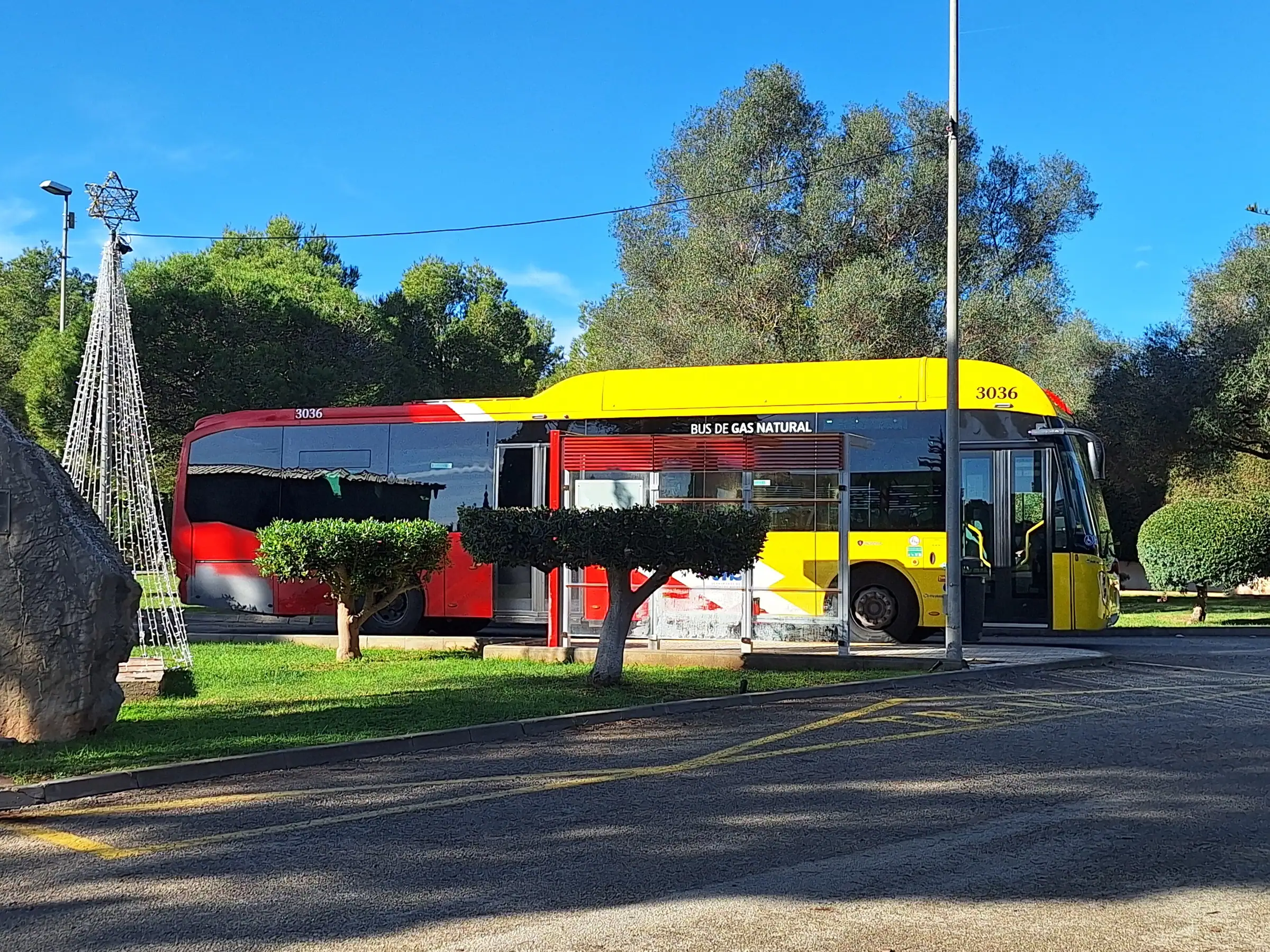
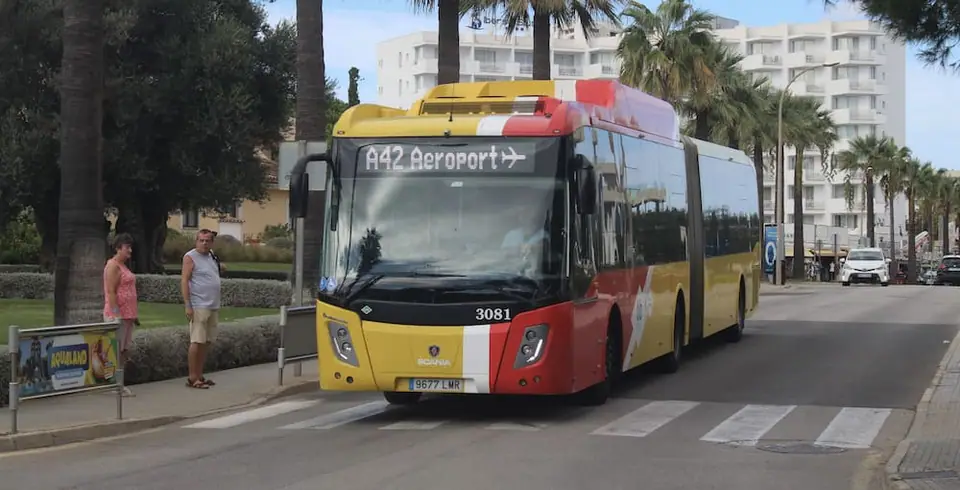
The red and yellow buses (TIB)
This is the main network, the one you need to get out of the city. It serves the rest of the island: Valldemossa, Alcúdia, the Caves of Drach and more. In Palma, buses leave from the Estació Intermodal on Plaça d’Espanya. The bus station is underground: do not look for buses at street level, take the escalators down. Keep a close eye on timetables too, as they change sharply between winter and summer. Always check on Google Maps or on the official website, tib.org, before setting off.
The blue buses (EMT)
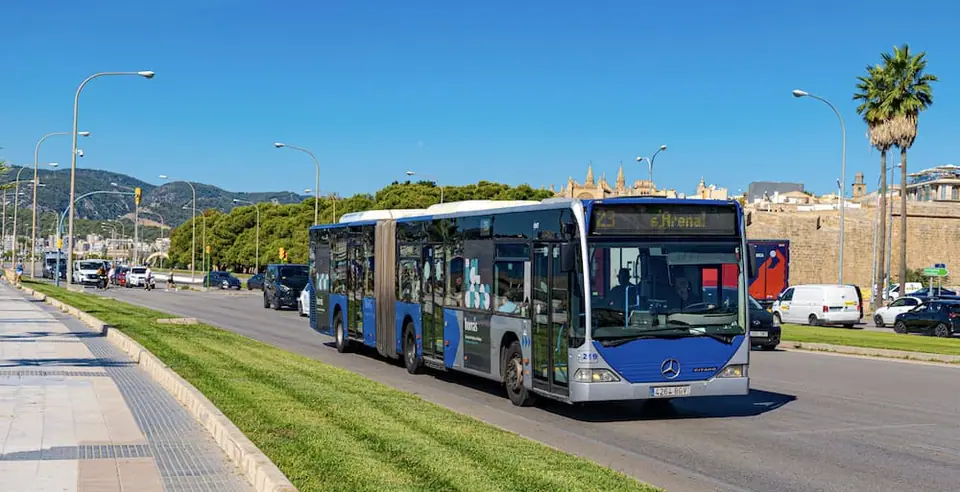
These are Palma’s city buses. They do not go far, serving only the historic centre, the port and the city beach. The payment system is different here: you only tap your bank card when you get on (just “Tap in”), or you pay the driver in cash. A ride costs €2 in cash or €1.20 by bank card. The most useful lines are line 4 for the coves of Illetas and line 25 for the beach at S’Arenal.
The train and metro (SFM)
Mallorca has a proper rail network, fast and punctual, which also leaves from the underground station on Plaça d’Espanya. It is very handy for the market in Inca on Thursdays or Sineu on Wednesdays, without the traffic jams.
A common mix-up: do not confuse this modern public train with the famous wooden Sóller train. The latter is a private tourist attraction, very expensive, which leaves from a small station above ground. Your usual payment card will not work there.
Which transport should you choose, and how do you pay less?
| Network | Colour | Best for | Best way to pay | Fare |
|---|---|---|---|---|
| TIB bus | Red / yellow | Crossing the island, going to the beach, changing towns | Bank card (Tap in / Tap out) | Decreasing (very cheap) |
| EMT bus | Blue | Palma centre, port and airport | Bank card (Tap in only) | €2 (€1.20 by card) |
| Train (SFM) | White / yellow | Markets (Inca, Sineu), fast and traffic-free | Bank card (gates) | Decreasing (very cheap) |
| Sóller train | Wood (vintage) | Pure sightseeing (scenery) | Ticket office or online | Expensive (€30 return) |
The key TIB bus routes for sightseeing
The TIB network is built like a star around Palma. If you are staying in Palma, you are at the starting point of almost every line.
Northern beaches (Alcúdia, Pollença): lines 302 and 301
If you dream of long stretches of white sand and turquoise water, line 302 is your best friend. It links Palma with the bay of Alcúdia and Can Picafort by motorway, which makes the trip quick and comfortable. For a more traditional feel in Port de Pollença, or to get closer to Cap de Formentor, choose line 301. These buses are often double-deckers: head for the front seats upstairs for a free panoramic view all the way across the island.
The mountains (Valldemossa, Sóller): lines 204 and 203
The Serra de Tramuntana is very easy to reach without a car. Line 204 is probably the most popular with travellers: it heads to Sóller through the tunnel, avoiding the many bends of the mountain pass. Once there, you can connect with the old tram down to the port. To reach the romantic village of Valldemossa, take line 203. In high season these lines are very busy; try to reach the underground station 15 minutes before departure to be sure of a seat.
Southern coves (Cala d’Or, Santanyí): lines 515e, 501, 517 and 515
The south-east of the island means slightly longer journeys. From late March to late October, line 515e takes you to Santanyí and the resort of Cala d’Or. The rest of the year, take the 501 to Campos, then the 517 for Santanyí or the 515 for Cala d’Or. From Cala d’Or, the summer line 521 runs down to the Mondragó nature park.
Airport buses (Aerobus)
Do not spend €40 on a taxi if you are travelling light. Lines A1 (to central Palma) and A2 (to S’Arenal), run by Palma’s EMT, are very frequent. If you are staying in another resort such as Magaluf or Alcúdia, there are direct lines from Palma airport (such as the A32 for the north or the A11 for Magaluf), so you do not have to change in the city centre.
Mallorca without a car: a one-week itinerary by public transport
You can see the essentials in seven days with nothing but your bank card and a backpack, if you leave out the hardest-to-reach coves.
The first few days are best spent in Palma. The capital is best explored on foot, from the cathedral to the lanes of the old Jewish quarter. When you feel like a swim, the blue EMT buses take you to the beaches of Illetas or Portixol in a few minutes.
In the middle of the week, head for the mountains. Bus 204 takes you to Sóller for a day between sea and mountains. The next day, carry on to Valldemossa on line 203. The bus has a big advantage here: you avoid the overflowing car parks that often spoil the visit for drivers.
At the end of your stay, change scenery with the north on line 302. The old town of Alcúdia, ringed by its walls, is entirely pedestrianised, especially on market days (Tuesday and Sunday). If you like authentic local life, do not miss the Sineu market on Wednesday morning. It is the one day when the train (from Plaça d’Espanya) is a better choice than the bus, dropping you right in the thick of it with no parking worries.
The limits of the bus: when to book an excursion
TIB buses do not go everywhere. Some of Mallorca’s most famous spots are where public transport reaches its limits, either because the road is too difficult or because environmental protection restricts access.
Sa Calobra and the Torrent de Pareis are the classic example. The winding road is spectacular but daunting, and scheduled buses are rare and often full. To enjoy it in comfort, the easiest option is the boat from Port de Sóller or an organised excursion by private coach that handles all the logistics.
The same goes for Cap de Formentor. From mid-May to mid-October, the road is closed to private cars from 10am to 10pm to protect the site (only the beach car park remains accessible, while spaces last). There is a shuttle bus (the 334), but it is often packed. If you want to see the lighthouse and the beach without jostling, boat trips from Alcúdia or Pollença are often a more pleasant alternative, with views you do not get from the road.
Finally, for the famous beach of Es Trenc, the bus drops you quite far from the shore (at Ses Covetes), so you have to walk in the sun. Without a car, this is one of the rare cases where a shared transfer or a dedicated excursion can be worth the money to make the most of your time on the beach.
FAQ
How do you pay on the bus in Mallorca?
With a contactless Visa, Mastercard or Maestro card, with no app and no ticket office. Tap the card on the reader by the driver when you get on, then on the one by the rear door when you get off. If you forget to tap out, TIB charges a €0.30 penalty per person.
Where do you catch the TIB bus in Palma?
At the Estació Intermodal on Plaça d’Espanya. The bus station is underground: take the escalators down. The SFM train leaves from the same station.
Which TIB bus goes to Sóller and Valldemossa?
Line 204 goes to Sóller through the tunnel and line 203 serves Valldemossa. In high season, arrive 15 minutes before departure to get a seat.
Which bus goes from Palma airport?
EMT lines A1 (central Palma) and A2 (S’Arenal) run very frequently. Direct lines also serve other areas, such as the A32 for the north or the A11 for Magaluf.
Can you visit Mallorca without a car?
Yes. From Palma, TIB buses reach Sóller (204), Valldemossa (203), Alcúdia (302) and Port de Pollença (301), and the train serves the markets of Inca and Sineu. Only a few places, such as Sa Calobra, Formentor or Es Trenc, are easier with an excursion.
Read next
Getting around Mallorca: buses, trains, taxis, car hire and ferries
Getting around Mallorca: A1 airport bus, TIB and EMT buses paid by card, Sóller train and metro, taxi fares, car hire, parking in…
Mallorca weather by month: the best time to visit, sea temperature and prices
The best time to visit Mallorca is June or September: 28°C, a 21-25°C sea, fewer crowds. Mallorca weather by month (AEMET…
Mallorca in winter: temperatures, what’s open and a month-by-month verdict
Is Mallorca in winter worth it? October to February month by month: temperatures, sea, rain, what closes, almond blossom and how…