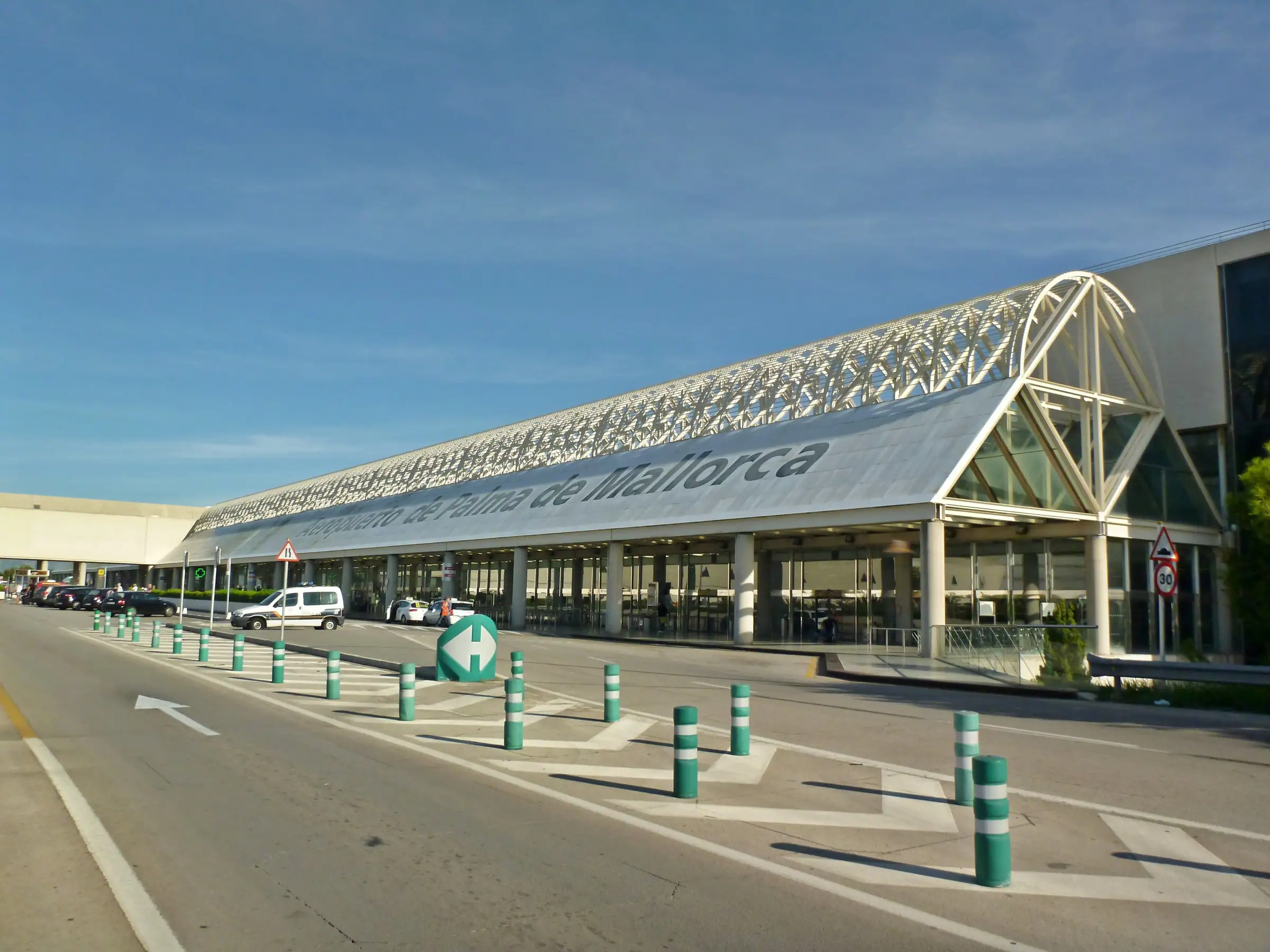
Palma airport (PMI): modules, A1 bus to the city centre, taxis and practical tips
11 min readUpdated  By Antoon
Contents
- Palma airport: Spain’s third busiest, with 33.8 million passengers
- Palma airport to the city centre and beyond: the choice that shapes your first two hours
- Inside the terminal: food, shopping and what to avoid
- July and August at PMI: what 33 million passengers mean for you
- Palma airport liquid rules, security and boarding
- Practical services at Palma airport
- Before you load the hire car
- FAQ
Palma airport (PMI) on a Friday evening in July: the baggage hall of module C, a belt that has been turning for twenty minutes, and two hundred people staring at the same strip of black rubber, hoping to see their suitcase appear. Outside, the sun is starting to drop over the bay, and every minute spent here is a minute less on a terrace. That is Palma airport in high season. Not a nightmare, but a place that rewards travellers who arrive prepared and punishes the rest. This guide is here to put you in the first group.
What follows is not a copy of the Aena website. These are the practical decisions that make a difference at every crossing, in both directions, whether in January rain or in August heat.
Palma airport: Spain’s third busiest, with 33.8 million passengers
The official figures published by Aena in January 2026 leave no doubt: 33.8 million passengers passed through PMI in 2025, up 1.5% on 2024. It is the airport’s all-time record, and it confirms what every island resident feels each summer: Mallorca is no longer a seasonal destination but a tourism machine that runs twelve months a year. With 246,486 aircraft movements in 2025, PMI ranks as Spain’s third airport behind Madrid-Barajas and Barcelona-El Prat. You are landing in one of the busiest terminals on the continent.
Most travellers come from abroad. In 2025, 24.8 million passengers took international flights, against 8.99 million on domestic routes. The top three source markets are Germany, the United Kingdom and Switzerland.
Four modules: the layout to understand
PMI is not organised like a classic airport with separate terminals. It works with one central building for departures and arrivals, connected to four independent boarding modules: A, B, C and D. Each module has its own gates, its own services and its own atmosphere.
- Module A handles non-Schengen international flights, mainly routes to the United Kingdom and long-haul destinations. If you arrive from London or New York, this is where you land.
- Module B is for inter-island flights to Ibiza, Menorca and the Canaries. If you are passing through Palma to reach another Balearic island, this is your module.
- Module C is the largest and busiest: it handles most Schengen European flights. In July and August it is the centre of the traffic, so allow extra time.
- Module D was closed from November 2025 to March 2026 for the renovation of its ceiling and reopened from 27 March 2026.
2026: a €560 million upgrade you will see from the inside
What most guides do not mention is that Palma airport is undergoing a complete transformation: €560 million of investment, more than 25 companies on site, and a full overhaul with 2026 as the final year of works. It is the airport’s biggest refurbishment in twenty years.
In practice, this is what you will see in 2026: new security checkpoints fitted with latest-generation scanners that let you leave laptops and liquids in your cabin bag, which makes the queues move far more smoothly. Module A has already been renovated and has brighter spaces. Module D was renovated during winter 2025-2026. The seventh level of the main car park has opened with 750 spaces, ready for solar panels. This is not an airport struggling with building works: it is an airport modernising in real time, and the result will be far more pleasant than old photos suggest.
Palma airport to the city centre and beyond: the choice that shapes your first two hours
Everyone makes this decision in the ten minutes after collecting their bags, often tired after the flight, with children tugging at an arm or the island heat hitting as soon as the automatic doors open. Badly prepared, it can cost you an hour of pointless travel or a hundred euros of unnecessary taxi fares. Well prepared, it gets you to your destination in the best possible conditions.
| Option | Time to central Palma | Guide price 2026 | Best for |
|---|---|---|---|
| EMT bus A1 | Depends on stops (10.5 km) | €5 (€3 by card) | Solo travellers or couples staying in Palma |
| Taxi | About 15 min without traffic | About €20 by day, about €22 at night | Families with luggage, late arrivals |
| Private hire (Uber) | Depends on the wait | Shown in the app | Anyone who wants to book from their phone |
| Car hire | Depends on destination | From €10 a day | Any stay outside central Palma |
Palma airport to city centre by bus: the A1
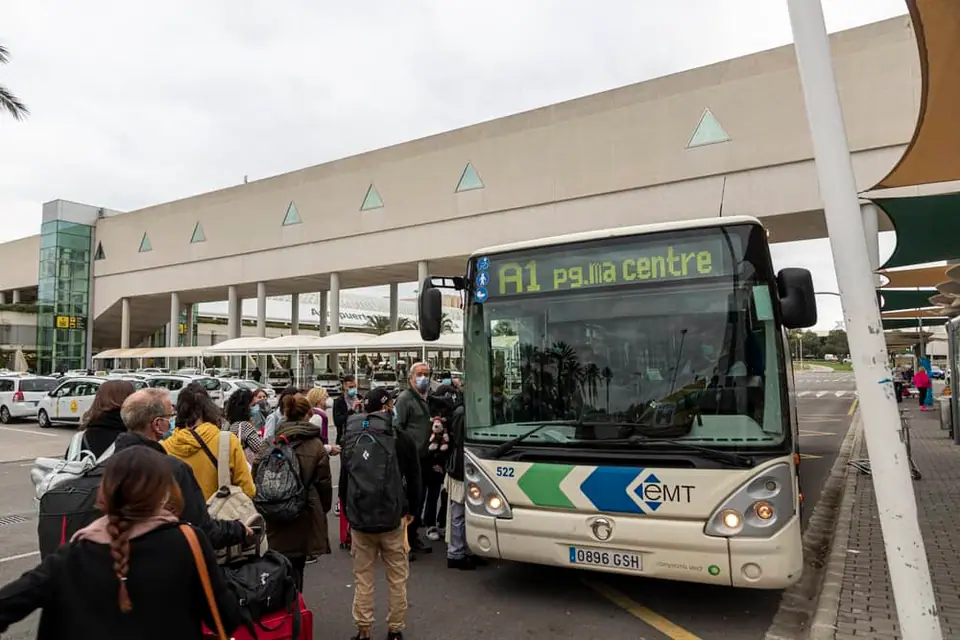
The EMT’s A1 line links the airport with central Palma for €5 in cash, or €3 with a contactless bank card (a 40% discount). On weekdays the first bus leaves the airport at 5.30am, buses run every 15 minutes during the day and night departures continue until 3.10am. It serves Porta des Camp, Plaça d’Espanya (the intermodal station) and Passeig Mallorca; the A2 serves Can Pastilla, Playa de Palma and s’Arenal. It is the obvious choice for a solo traveller or a couple with one bag each, staying in Palma.
With two suitcases, a child seat and a pushchair, though, it is a bad idea.
Buses from Palma airport to the rest of the island
If your hotel is in Alcúdia, Pollença or the south of the island, the A1 is no use to you: it only goes to Palma. For the rest of the island, the TIB “Aerotib” buses leave from level 0:
- All year: A11 to Magaluf and Peguera, A51 to Campos.
- Summer: A32 to Alcúdia, A42 to Cala Millor.
- Winter: A33 to Alcúdia, A43 to Manacor.
Fares and journey times are in our guide from the airport to your hotel. Otherwise, buses leave from the Estació Intermodal on Plaça d’Espanya, which means changing in Palma.
Taxi from Palma airport: cost and when it makes sense
A taxi from PMI to central Palma costs about €20 by day (€22 at night) on the meter, with a fixed €4.65 supplement for any journey from the airport and a minimum fare of €16.95. Allow a quarter of an hour without traffic. The taxi rank is on level 0, on the arrivals side: Aena advises taking only taxis from the official rank and asking for a receipt.
A taxi is worth it in three specific cases: a late-night arrival with accommodation outside Palma, when the TIB buses have stopped, a family with young children and lots of luggage, or accommodation in the lanes of the old town that a hire car cannot reach. In every other case, between the bus and car hire, the taxi is not the best value.
Car hire at Palma airport
If you are staying anywhere other than Palma, hire a car. It is the most practical option. The rental desks are on the ground floor of the terminal, just after baggage reclaim. Avis-Budget, Europcar, Goldcar, Hertz, OK Mobility, Record Go and Sixt have desks in the terminal; other firms pick you up by shuttle. In 2026, prices start at around €10 to €15 a day in low season for a small car, but they double or triple in July and August if you have not booked ahead.
Two classic traps to avoid. The first is fuel. Check whether the contract is full-to-full or full-to-empty. With full-to-empty, you pay for fuel at a high price. Always choose full-to-full and fill up before returning the car. The second is the excess. Basic insurance covers damage but with an excess of €1,000 to €1,500. Remove it: €20 to €30 a day at the desk, or €6 to €8 a day for excess cover bought online, which spares you nasty surprises on small mountain roads where scrapes happen quickly.
Inside the terminal: food, shopping and what to avoid
PMI is not an airport where you have a great time, but it is far from as grim as some big European hubs. You can eat decently, buy something useful, and there are a few traps to know before you get your card out.
Eating at Palma airport
For food, Palma airport plays it safe: Burger King, McDonald’s, Subway and standard cafés. Nothing remarkable, but nothing disastrous either. There are also Spanish chains such as Goiko, Rodilla and Enrique Tomás; the full list is on the Aena website.
A practical tip before you fly home: look for a kiosk selling ensaïmadas, the traditional Mallorcan spiral pastry, light and made with saïm (lard). Several shops in the terminal sell them. It is the best edible souvenir you can take home.
Duty free: what is actually worth it
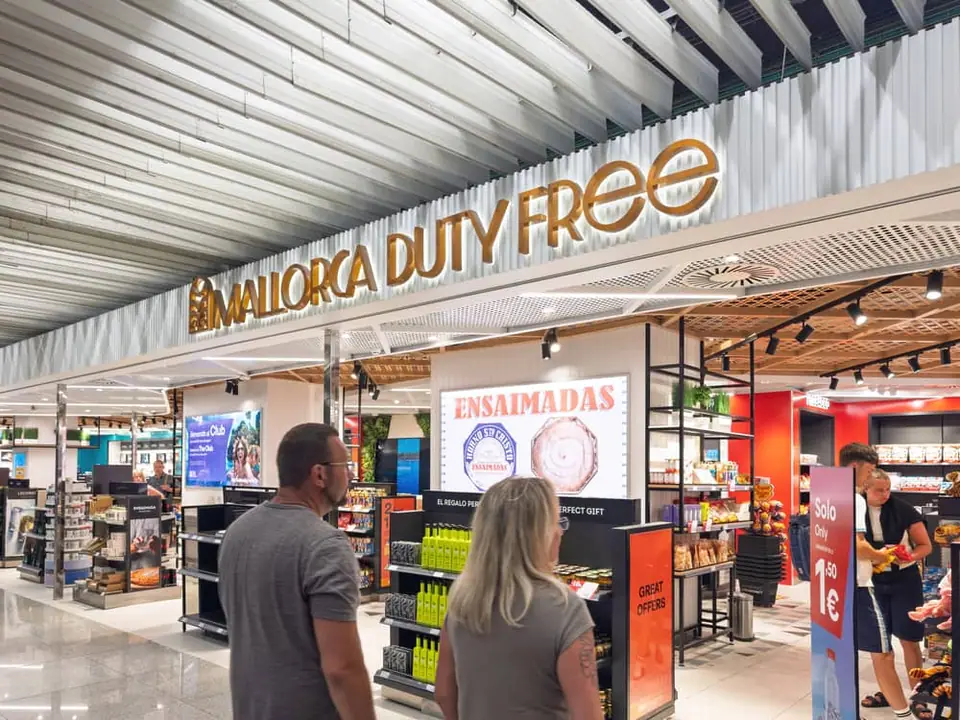
On the departures side, after security, PMI has Mallorca Duty Free shops and Express Duty Free counters. For flights to countries outside the European Union, the savings on perfume, alcohol and tobacco are real. For flights within the EU, however, duty free offers no tax advantage. What you will pay more for than in a Mallorcan supermarket are generic souvenirs. Mallorca pearls, ceramics and local liqueurs are consistently cheaper in town.
VIP lounges: when they pay off
PMI has five paid lounges run by Aena: Valldemossa VIP on level 4 of the terminal, Llevant VIP in module A, Mestral VIP in module B for inter-island flights, Mediterranean VIP in module C and Formentor VIP in module D. Some close in winter or during works. Access is booked on the Aena website: €48 per adult and €22.20 per child.
It is only worth it in two situations: your flight is delayed by more than an hour in high season and the gate area is packed, or you are travelling with children and need a quiet space to wait. For a quick 45-minute transit, it is money wasted.
July and August at PMI: what 33 million passengers mean for you
The 33.8 million passengers a year are not spread evenly over twelve months. July and August take a disproportionate share of the traffic. In August 2025, PMI handled 4.7 million passengers, more than 150,000 a day on average.
What it means for you: baggage belts can turn for 30 to 45 minutes before your suitcase appears. Security queues at departure can reach 40 minutes on a Saturday morning. Car hire desks have queues of 20 to 30 minutes even with a booking. The long-stay car parks are full from Thursday evening. These are not exceptions; it is the norm in high season.
The strategy that changes everything: get to the airport 3 hours before departure in July and August, not 2. Use Fast Track if you have no hold luggage. Collect your hire car the day before departure if you are staying in Palma, to avoid the queue at the desk on the day. And above all, plan your parking if you are leaving in your own car: the airport’s P1 to P8 car parks vary hugely in price and availability.
Palma airport liquid rules, security and boarding
The good news for 2026 is that the new security checkpoints in the terminal have changed the game. The new-generation scanners no longer require you to take laptops or liquids out of your cabin bag. Getting through is much smoother than before, as long as you do not arrive at the same time as three German charter flights.
If you are in a hurry, Fast Track can be bought on the Aena website before you travel. It gives you a priority lane at security. In high season it is worth the €16.55 it costs if your flight leaves between 6am and 11am, the busiest slots of the day.
The official Aena app, available on iOS and Android, is the most underused tool among travellers. It shows your flight status in real time, your gate as soon as it is assigned, and a map of the airport with geolocation. It is free and can save a tight connection. Download it before you leave, not in the security queue.
On connections through PMI, be careful. PMI is not a connecting hub. It is a terminus airport designed for point-to-point flights. Transit facilities are limited, staff trained for complex connections are rare, and if your first flight is late, your connection is rarely protected. If your route involves a stop in Palma, allow at least 2 hours 30 minutes of transit in low season and 3 hours in summer. Anything less is a gamble.
Practical services at Palma airport
Luggage storage: the left-luggage office, run by Superskunk, is on level 2 in the check-in area: €10 for a small cabin bag, €15 for a medium or large suitcase. Drop-off from 9am to 2pm, collection from 8am to 8pm, every day. Handy if you have an evening flight and want to spend the day in Palma without dragging your cases around.
Changing money: no need. Pay by card, or withdraw cash from a machine once you are in town. If you need cash at the airport, the terminal has four La Caixa cash machines, as well as Euronet and Change Group machines: check the fees shown on screen before you confirm.
WiFi: it is free throughout the terminal. The connection is fine for messages or internet calls, less stable for streaming 4K video during a long wait.
Before you load the hire car
The people who struggle at PMI are almost always those who underestimated the airport. They arrive without Fast Track, without a car booking, without having checked their gate in the app. They lose time at every stage, and time lost at the airport is time taken from the island.
PMI is a good airport, in the middle of a modernisation, well connected and fairly easy to read once you know its logic. The area where you stay on the island should directly shape how you leave the airport: Palma by bus, everywhere else by car. It is the simplest rule to remember.
Now head outside. The late-afternoon light over the bay of Palma will not last forever.
FAQ
How do I get from Palma airport to the city centre?
The EMT A1 bus serves Porta des Camp, Plaça d’Espanya and Passeig Mallorca for €5 in cash or €3 by contactless card. A taxi costs about €20 by day and €22 at night, and takes around 15 minutes without traffic.
How much is a taxi from Palma airport to the city centre?
About €20 by day and €22 at night on the meter, including the fixed €4.65 airport supplement, with a minimum fare of €16.95. Take taxis only from the official rank on level 0 and ask for a receipt.
Do you have to take liquids out at Palma airport security?
No longer at the new security checkpoints: their latest-generation scanners let you leave laptops and liquids in your cabin bag, which makes the queues much faster.
How early should I get to Palma airport?
In low season (November to April), 2 hours is plenty. In high season (June to September), allow 3 hours for morning flights and 2 hours 30 minutes for afternoon and evening departures.
Can you get to the north of the island by public transport from the airport?
Yes: TIB buses link the airport directly with the main resorts, including Alcúdia (A32 in summer, A33 in winter), but less often than the A1. Otherwise, change at Plaça d’Espanya in Palma. It is the strongest argument for car hire if you stay in the north.
Read next
Getting around Mallorca: buses, trains, taxis, car hire and ferries
Getting around Mallorca: A1 airport bus, TIB and EMT buses paid by card, Sóller train and metro, taxi fares, car hire, parking in…
Mallorca weather by month: the best time to visit, sea temperature and prices
The best time to visit Mallorca is June or September: 28°C, a 21-25°C sea, fewer crowds. Mallorca weather by month (AEMET…
Mallorca in winter: temperatures, what’s open and a month-by-month verdict
Is Mallorca in winter worth it? October to February month by month: temperatures, sea, rain, what closes, almond blossom and how…