Mallorca itinerary for 7 days: a one-week road trip, day by day, with budget
13 min readUpdated  By Antoon
Contents
- One week in Mallorca: the “two bases” strategy
- Day 1: Palma, the capital
- Day 2: the south-east coves
- Day 3: caves and lighthouses
- Day 4: the big crossing to the north
- Day 5: Cap de Formentor
- Day 6: Sa Calobra, the serpent road
- Day 7: Valldemossa and Deià
- How much does a week in Mallorca cost?
- Adapting the itinerary to your trip
- FAQ
This Mallorca itinerary for 7 days is a road trip built around two bases: four nights in the south-east, then three nights in the north-west. The loop takes in Palma, Caló des Moro, the Caves of Drach, Pollença, Cap de Formentor, Sa Calobra, Valldemossa and Deià, without spending your holiday behind the wheel.
Seven days is both a lot and frustratingly little. The first mistake many travellers make is to look at the map and think: “It looks small, we can do it all from one hotel.”
That’s the surest way to spend your week in the car.
Mallorca’s geography is deceptive. The Serra de Tramuntana, the UNESCO-listed wall of mountains that shelters the whole west of the island, turns any 30 km drive into an hour-long expedition. Crossing the island from south to north is quick thanks to the motorway, but as soon as you head for the wild coast, journey times shoot up.
This itinerary is built around one obsession: logistics. The aim is a coherent loop that keeps fatigue down and maximises time in the water or in front of a sunset, with the week split into two areas to avoid pointless back-and-forth.
One week in Mallorca: the “two bases” strategy
If you book a single hotel for the week (in Palma, for example), you’ll wear yourself out. Cap de Formentor, in the north, is 1hr 15min from Palma each way. The same goes for the coves in the east. After three days, you’ll hate the road.
The answer is to split the stay in two. Spend your first four nights in the south-east, in the triangle formed by Campos, Santanyí and Colònia de Sant Jordi. It’s the driest, wildest part of the island, all red earth and dry-stone walls. Above all, it gives you direct access to the finest coves (Caló des Moro, Cala Llombards) without crossing the island every morning.
For the last three nights, move to the north-west. Go for Alcúdia (for the beach and quick access), Pollença (for charm) or Port de Sóller (for mountain atmosphere). If you’re still unsure which town to choose, see our guide to the best areas to stay in Mallorca. You’ll be perfectly placed to tackle the famous roads to Sa Calobra and Formentor before the coaches arrive.
Day 1: Palma, the capital
Palma is lively, noisy and sophisticated. The classic mistake is trying to park “for free” in residential streets. Forget it straight away. Between the ORA zones (blue lines, limited to two hours) and the ACIRE zones (residents only, with cameras), you’ll end up with a fine.
Head straight for the underground car park at Parc de la Mar. It isn’t cheap (around €3 an hour), but the pedestrian exit opens right onto the cathedral, with the artificial lake in the foreground. It’s worth it.
Morning: light and patios
Start with the cathedral (La Seu), and don’t settle for the nave. Buy the specific ticket for the terraces: you walk on the roof, between the flying buttresses, looking down on the patios of the Almudaina Palace and across the Bay of Palma. On the way down, wander the streets behind the cathedral, around Carrer de Morey. Peer through the gates and you’ll see the famous Mallorcan patios, paved courtyards with palm trees and wells, a legacy of the old aristocratic houses.
Lunch: the market test
At midday, steer well clear of the restaurants on the Plaza Mayor: they’re the classic tourist trap. Walk ten minutes to the Mercat de l’Olivar, a covered market that smells of fresh fish and lemon. At the back of the fish hall, counters cook the catch of the day in front of you. Order a fritura variada (mixed fried fish) or grilled Sóller prawns. You eat standing up, elbow to elbow with locals. For more ideas for this day, see our detailed itinerary to explore Palma on foot.
Afternoon and evening
Keep the afternoon for shopping on the Passeig del Born, the city’s smartest avenue, and end the day in Santa Catalina. The former fishermen’s district has become a haunt of expats and well-heeled young locals. Carrer de la Fàbrica is pedestrianised and lined with terraces. For a drink, the rooftop of the Hostal Cuba has a superb view over the harbour at sunset.
Day 2: the south-east coves
Today you’re after the postcard shot: translucent turquoise water. But you won’t be alone, so timing is everything.
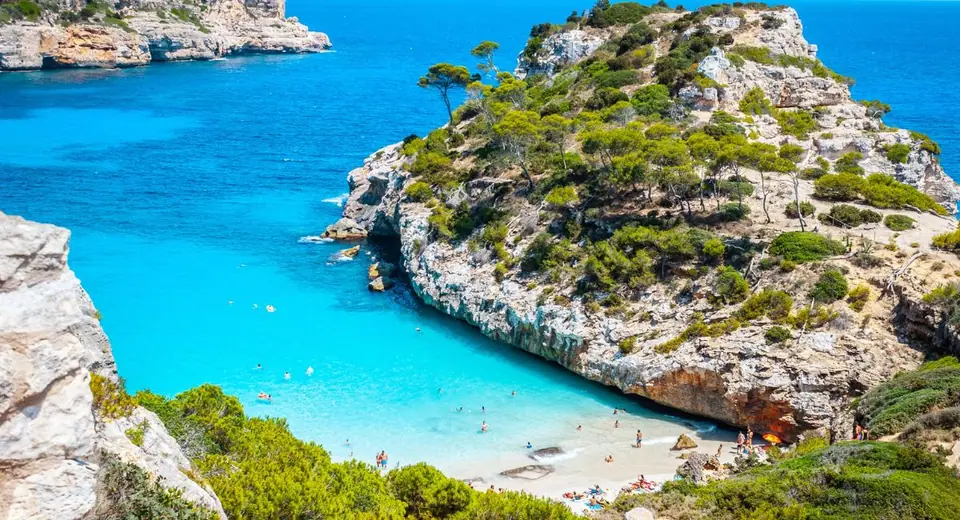
Your top target is Caló des Moro. It’s arguably the most beautiful cove on the island, a natural pool framed by white cliffs. It’s also the smallest, with almost no sand, just rocks. The rule is simple: be parked at the free car park (marked on Google Maps; don’t try to park in the residential estate or you’ll be towed straight away) before 9am. After that, you’ll have to walk for kilometres or turn back. The path down is a little steep, so keep your trainers on. At the bottom, the setting repays the effort: the water is so clear that the boats seem to float in mid-air. Our Caló des Moro guide covers access and parking in detail.
Around midday, when the crowds become oppressive, climb back up and head for Cala Figuera. It isn’t a place to swim but a traditional fishing harbour that has escaped the concrete. Just white fishermen’s houses with green shutters that drop straight into the water. It’s the ideal place for grilled fish at Bon Bar or L’Arcada, watching the llaüts (traditional boats) come back from fishing.
In the afternoon, if you want sand and space, try Cala Llombards or, wilder still, the Mondragó Natural Park. S’Amarador beach, reached by a short coastal path, is often less crowded than its neighbour and has a natural setting free of any buildings.
Day 3: caves and lighthouses
You stay on the east coast but move a little further north, for a more varied day that mixes geology and heritage.
You can’t talk about the east without mentioning the Caves of Drach in Porto Cristo. Let’s be honest: it’s an industry. Groups shuffle through in single file. And yet you should go. Why? Because Lake Martel, buried deep underground, is a marvel. The moment the lights go out and the boats glide in with musicians playing Chopin is pure kitsch, yet strangely moving. Take the first slot of the morning (10am) to avoid the worst of the crowds. Tickets and timings are in our Caves of Drach guide.
For lunch, skip Porto Cristo, which lacks soul, and carry on to Portocolom, one of the most appealing spots on the east coast. The bay is huge and sheltered, and the old quarter around the church has kept its colourful houses and a great deal of charm. You eat very well there (HPC or Sa Llotja for a treat) without feeling like a walking wallet.
In the afternoon, drive up to the Capdepera lighthouse or the medieval castle that towers over the town. On clear days, you can make out the coast of Menorca on the horizon. It’s a windy, wild viewpoint, a contrast with the beaches.
Day 4: the big crossing to the north
This is the pivotal day. You pack your bags and leave the dry south for the mountainous north.
On the way, stop in the town of Pollença (not to be confused with Port de Pollença). It’s a town of ochre stone at the foot of the mountains. The challenge of the day: climbing the 365 steps of the Calvari, a stairway lined with cypress trees that runs straight up to a small chapel. Your calves will burn, but the view over the tiled roofs and the surrounding countryside is spectacular. On the way down, reward yourself with a homemade ice cream on the Plaça Major.
The afternoon brings a complete change of scene at Playa de Muro. Forget the small rocky coves of the south: this is Florida. Six kilometres of white sand, milky turquoise water and, above all, very shallow depths. You can stand up 50 metres out. With children, it’s ideal; swimmers will have to walk a long way out. The emblem of the place is the long wooden jetty reaching into the sea, where excursion boats leave from. It’s the photo everyone takes.
Check into your new hotel in the evening. You’re now well placed for the two biggest days.
Day 5: Cap de Formentor
Today you head to the end of the world, at the northern tip of the island. But access to the Formentor lighthouse has become a legal puzzle. To protect nature, the road (Ma-2210) was closed to private vehicles from 10am to 10pm, from 15 May to 18 October in 2026: only the Formentor beach car park stays open until it’s full, and the stretch to the lighthouse is reserved for authorised vehicles.
Number-plate-reading barriers control access to each section, and entering the restricted zone without authorisation exposes you to a fine. The system is strict, but there are ways to visit Formentor without getting fined, mainly by playing with the timings.
You have two strategies:
- The early start (best for photographers): go through the control barrier (on the way out of Port de Pollença) early enough to be past Formentor beach before 9.58am, as the DGT (Spain’s traffic authority) requires for the lighthouse section. Once inside the zone, you can drive, park at the lighthouse, enjoy the dizzying view over 300-metre cliffs and come back down whenever you like.
- The relaxed option: leave the car at the free car park in Port de Pollença and take a boat, or the TIB 334 bus (Alcúdia, Port de Pollença, Formentor beach and lighthouse), which is allowed during the restriction. The boats drop you at Formentor beach, a narrow, pine-fringed and very smart beach (the legendary Formentor hotel is right there). Arriving by sea is majestic and spares you the hairpins.
Whichever you choose, don’t miss the Mirador Es Colomer on the way back. The shark-fin-shaped rock rising from the sea is one of the most powerful images of Mallorca.
Day 6: Sa Calobra, the serpent road
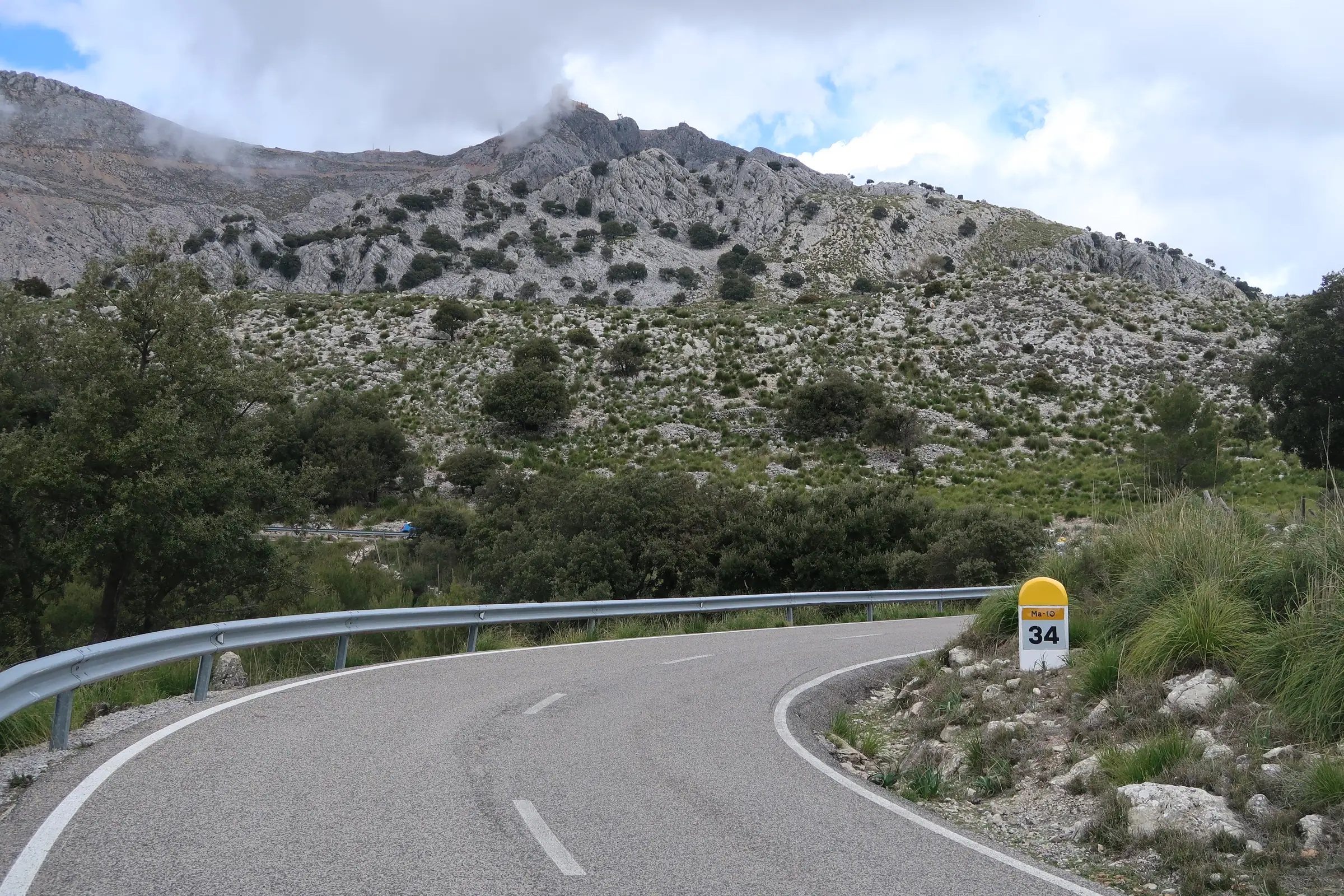
If you love driving, this is the big day. If you suffer from vertigo, take a deep breath. The MA-2141 road down to Sa Calobra is unique. It was designed by the engineer Antonio Parietti to follow the mountain without a single tunnel. The result is a string of hairpin bends, including the famous “Tie Knot” (Nus de Sa Corbata), a 270-degree bend where the road passes under itself.
Mind the timing: this road is a playground for coaches, and meeting one on a hairpin is stressful. To avoid them, drive down before 10.30am (when they arrive) or after 1pm (when they’re all at the bottom for lunch). Use engine braking on the way down. If the drive worries you, read our full guide to driving the Sa Calobra road before you set off.
The road’s end isn’t the end of the visit. Park (the car park is paid and expensive, with no alternative) and walk to the right. You go through two tunnels cut into the rock, with small windows onto the sea. At the end of the tunnel comes the shock: the Torrent de Pareis, a giant canyon, a rift in the mountain that opens onto a small pebble beach. The acoustics are incredible and the setting lunar. It’s arguably the most impressive place on the island.
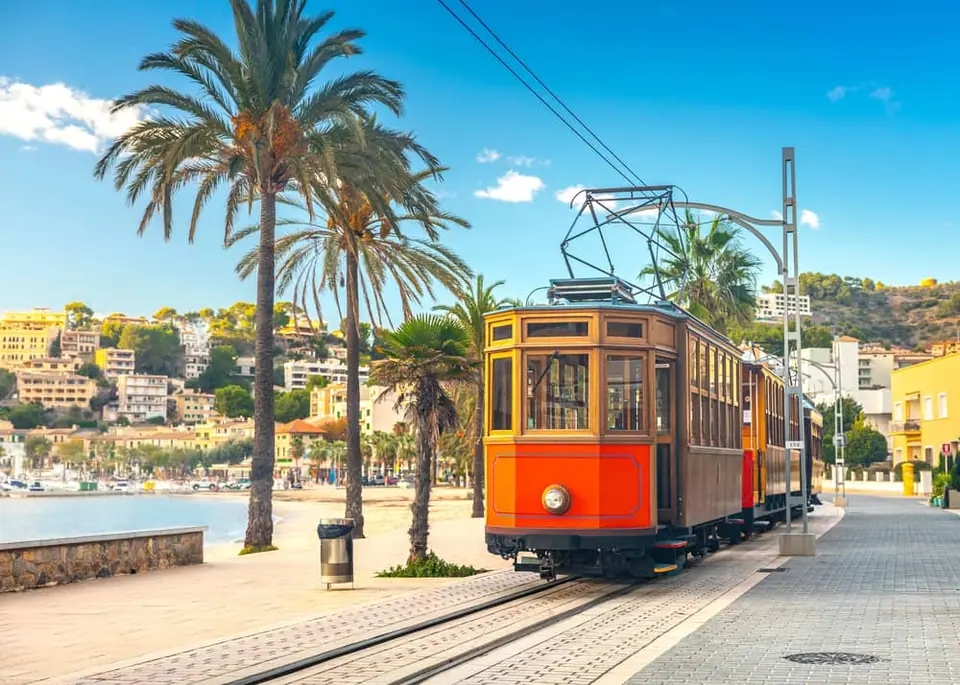
On the way back, stop at Port de Sóller for an orange ice cream and to watch the old wooden tram creak along the seafront.
Day 7: Valldemossa and Deià
For the last day, the car gets a rest and you take your time. You’re in the cultural heart of the Serra de Tramuntana.
First stop: Valldemossa, the postcard village par excellence, all honey-coloured stone and green shutters, smothered in flowers. Chopin and George Sand spent a winter here (cold and damp, according to their memoirs), which made the place famous. Visit the Charterhouse if you like history, but the real pleasure is simply walking the cobbled lanes away from the main street. Be sure to try the local speciality, the coca de patata: a small, very light potato bun dusted with sugar, eaten at breakfast with hot chocolate or coffee. More in our Valldemossa guide.
Then follow the coast road (MA-10) to Deià. The road runs along the cliff, with wide views over the sea. Deià is the village of artists, poets and… billionaires, with a bohemian-chic feel. Climb to the small cemetery at the top of the hill: oddly, it’s one of the finest sea views on the island.
For one last swim, go down to Cala Deià. Be warned: the road is narrow and the car park tiny. It’s a cove of large pebbles (water shoes essential, really), but the water has a unique emerald colour. A small, ramshackle restaurant perched on the rock (Ca’s Patro March) was used as a filming location for the series The Night Manager. Eating fish there, feet above the water, is the best way to say goodbye to Mallorca.
How much does a week in Mallorca cost?
Let’s be realistic: Mallorca is no longer a cheap destination. For a week like this one, for two people in 2026, here’s the budget to plan for:
- Car hire (7 days): around €300 for a small car such as a Fiat 500 if you book two to three months ahead. At the last minute in summer, it can double.
- Fuel: the mountains are thirsty. Allow €80 to €100.
- Accommodation: for decent hotels (3 stars or a simple agroturismo), it’s hard to find anything under €120 a night in season, so €840 for the week.
- Food: alternating picnics at lunchtime and small restaurants in the evening, allow €50 per person per day.
It adds up, but this route shows you the real face of the island, not just the hotel pool.
Adapting the itinerary to your trip
Here’s how to adjust the loop to your constraints.
Mallorca itinerary for 7 days with kids
Day 2 (the southern coves) can be an ordeal with a pushchair or little ones who need a nap. Access to Caló des Moro is steep and there’s no shade. The family alternative: replace that morning with Cala Gran beach in Cala d’Or, or spend the whole day at Mondragó Park (S’Amarador beach). The sand is fine, there’s shade under the pines and access is easy. The rest of the route (especially Playa de Muro and the Sóller train) works perfectly for children.
No driving licence?
To be frank, doing this full loop by bus in 7 days is impossible: the cross-island connections (east to north) take too long. Don’t change hotels. Base yourself in Palma only (Estació Intermodal). From there, take the direct buses to Valldemossa (line 203) and to Sa Ràpita, next to Es Trenc beach (line 508), as well as the train to Sóller. You’ll see less, but you won’t spend your holiday waiting at bus stops.
What to do if the weather turns?
Even in summer, a mountain storm is possible. If the sky is grey, don’t stay in the hotel:
- Wine: it’s the moment to visit the bodegas around Binissalem, in the centre of the island.
- Sport: the Rafa Nadal Museum in Manacor is indoors and interactive.
- Shopping: the FAN Mallorca centre is a safe bet to rescue a rainy afternoon.
Which way round should you drive?
This route follows the loop south, east, north, west (clockwise). It’s the best choice for one simple reason: the crescendo. You start with the flat land and the beaches and finish with the spectacular (the mountains, Sa Calobra, Deià). A sunset on the west coast makes a far stronger ending than a southern resort.
FAQ
How long does it take to cross Mallorca by car?
Crossing the island from south to north is quick thanks to the motorway: allow around 1hr 15min between Palma and Cap de Formentor, for example. In the Serra de Tramuntana, on the other hand, a 30 km drive can take an hour.
Where to stay for one week in Mallorca?
Two bases are better than one: the first four nights in the south-east, near the coves, then the last three in the north-west, in Alcúdia, Pollença or Port de Sóller, for Formentor and Sa Calobra.
How much does a week-long road trip in Mallorca cost?
For two people in 2026, allow around €300 for car hire booked two to three months ahead, €80 to €100 of fuel, €840 of accommodation (€120 a night in season) and €50 per person per day for food.
Can you do this 7-day Mallorca route without a car?
No, the full loop by bus is impossible in 7 days. Base yourself in Palma and use the direct buses to Valldemossa (line 203) and Es Trenc, as well as the train to Sóller.
Is one week in Mallorca enough?
Yes, if you split your stay between two bases: seven days covers Palma, the south-east coves, the Caves of Drach, Formentor, Sa Calobra and the Tramuntana villages.
Read next
Getting around Mallorca: buses, trains, taxis, car hire and ferries
Getting around Mallorca: A1 airport bus, TIB and EMT buses paid by card, Sóller train and metro, taxi fares, car hire, parking in…
Mallorca weather by month: the best time to visit, sea temperature and prices
The best time to visit Mallorca is June or September: 28°C, a 21-25°C sea, fewer crowds. Mallorca weather by month (AEMET…
Mallorca in winter: temperatures, what’s open and a month-by-month verdict
Is Mallorca in winter worth it? October to February month by month: temperatures, sea, rain, what closes, almond blossom and how…