Caló des Moro: parking, access and the best time to go
8 min readUpdated  By Antoon
Contents
- Why is Caló des Moro so famous?
- Caló des Moro parking: where to leave your car
- The walk to the cove: be ready for it
- Caló des Moro beach: Instagram vs reality
- The local tip: combine it with Cala s’Almunia
- Best time to visit Caló des Moro and avoid the crowds
- What you need to know before you go
- Where to eat and drink after the walk
- Is Caló des Moro worth it?
- FAQ
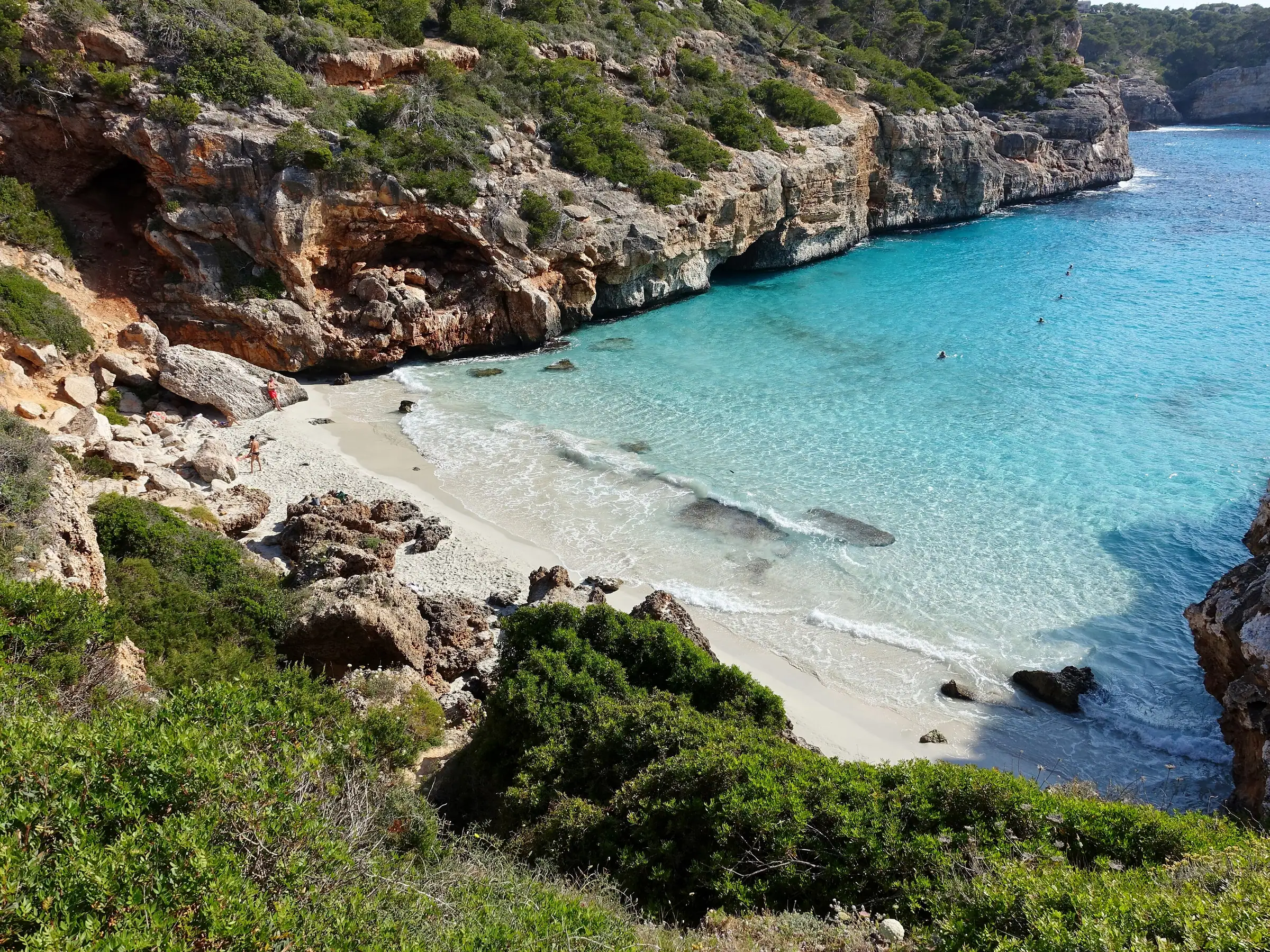
Caló des Moro is the cove you have seen in countless photos of Mallorca, and parking is the first thing to sort out before you go. In the pictures, it shows translucent water between two white limestone cliffs topped with pine trees: the image that sells Mallorca.
But there is a reality the photo does not show: the queue of cars, the crushing heat on the path down, and your neighbour’s towel touching your face once you reach the bottom. Caló des Moro is a marvel, probably the most beautiful cove on the island, but you have to earn it. It can be the best memory of your holiday or the worst moment of your trip if you turn up unprepared.
Here is exactly how to go about it: where to park, the walk, the best time and what to expect at the bottom.
Why is Caló des Moro so famous?
There is no shortage of beaches and coves in Mallorca. Why squeeze onto this one? The answer lies in a comparison you often hear on the spot: the water looks like “Gatorade”, or a chlorinated swimming pool. It is physics, not exaggeration.
The bottom of the cove is not dark rock or seaweed but extremely fine white limestone sand, a rare geological combination. When the sun is overhead, especially between 11am and 2pm, this sand acts as a huge reflector. It sends light back up through the water, creating that almost “radioactive” glow that seems to come from the seabed.
Add the steep cliffs that shelter the water from the wind (the surface is often like oil) and you get a perfect natural aquarium. It is raw, wild scenery: no hotel, no sunloungers, no branded parasols. This is Mallorca as it was 50 years ago, plus the crowds.
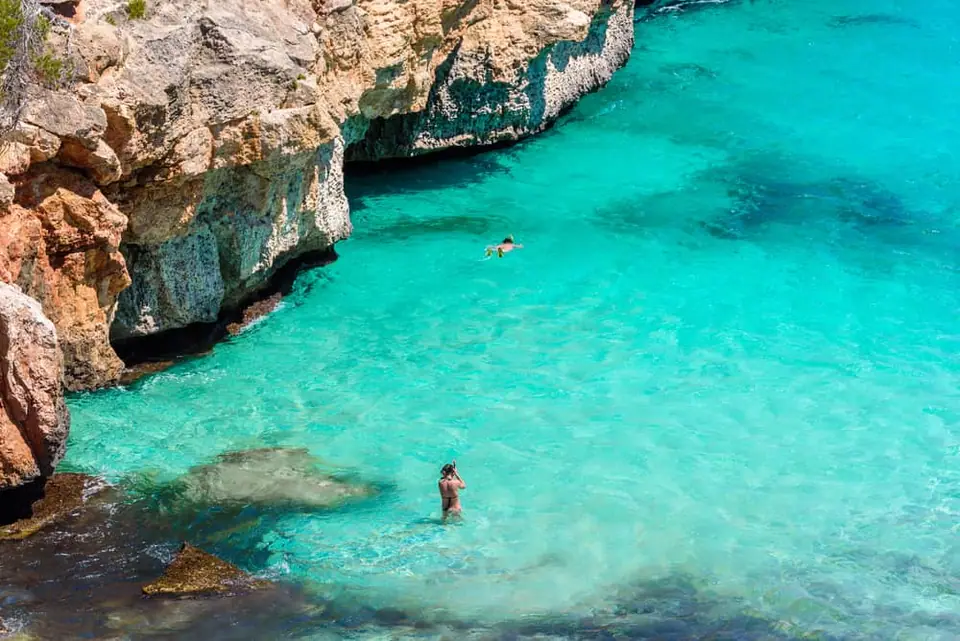
Caló des Moro has not always been fashionable. Until the 1990s it was the closely guarded secret of Santanyí’s residents. Families walked down on Sundays with enormous cool boxes. Erosion has also taken its toll: thirty years ago the sandy beach was much wider. Today the sea is taking it back, which is why space has become so scarce.
Caló des Moro parking: where to leave your car
Forget about parking “as close as possible” straight away. It was possible a few years ago, but Santanyí council has (rightly) put a stop to it to protect the peace of the residents of the small hamlet of Cala Llombards.
Today the few spaces near the cove are tightly controlled and the local police do not mess about. You will see yellow lines and no-parking signs everywhere. Do not push your luck: fines come quickly and the tow truck is busy in summer.
The safest option is the free car park set up specifically for visitors. It is well before the cove, along the road to Cala Llombards. It is large, but it fills up incredibly fast. When it is full, do not insist.
That is why hiring a small car is a real advantage here: it slips into spaces more easily than a big SUV.
The walk to the cove: be ready for it
From the car park, it is a walk of 25 to 30 minutes. Wear proper shoes rather than flip-flops.
You first follow the tarmac road through the housing estate (Carrer des Castellet), before turning onto a wilder path. That is where it gets tougher. The path is earthy, dusty and full of roots. In high summer the smell of sun-baked pines is intoxicating, but the heat is intense because there is little shade.
The final descent to the beach is down a fairly steep rock staircase, and that is often where the human “traffic jam” forms. Patience is your best friend. If you have elderly people with you, or small children in a pushchair, turn back. The access is not suitable for them at all. For families, nearby Cala Llombards, reachable directly by car and with fine sand, is a far better choice.
Caló des Moro beach: Instagram vs reality
This is the moment of truth. Once you are down, the view is superb. But you quickly notice one crucial detail: the beach is tiny.
Depending on the year and the winter storms, the amount of sand varies. Sometimes there are 20 metres of beach, sometimes barely 5. Most visitors end up on the rocks above or in hollows in the cliff. Comfort is basic: you sit on stone, roll your towel into a pillow and try not to slip.
The atmosphere is unusual. This is not a beach for ball games or bat and ball. It is a beach for looking and swimming. Voices echo off the rock walls in every language.
Photographer’s guide: getting the perfect shot of Caló des Moro
Let’s be honest: many visitors come for “the” photo. But getting it right here is not that easy because of the harsh contrasts, and plenty of people leave with overexposed pictures.
For the iconic shot (the one from above, with boats that seem to float in mid-air), do not go straight down to the beach. The best viewpoint is on the path along the cliff on the right-hand side (looking out to sea). There is a small natural promontory, often crowded, that gives you the perfect angle.
The secret is the light. The trap is shade. Because the cove faces south-east and is deeply enclosed, the right-hand cliff gradually puts the beach in shadow during the afternoon, even in summer. Come late in the afternoon and the water will have lost its turquoise sparkle and turned dark navy. For the “lagoon blue” photo, the ideal window is between 10am and 2pm, when the sun is high and lights up the seabed.
Go easy on filters, too. The natural colour is already so saturated that adding a “Vivid” or “Warm” filter on your phone makes the result look fake. Caló des Moro is beautiful enough on its own.
The local tip: combine it with Cala s’Almunia
Most visitors stop at Caló des Moro, take their photo, swim for 30 minutes and leave, worn out by the crowds. That is a mistake.
If you carry on along the path (a small trail links the two), you reach Cala s’Almunia, the old fishermen’s cove. There is no sand here, but slipways for the boats and smooth rock shaped by the waves.
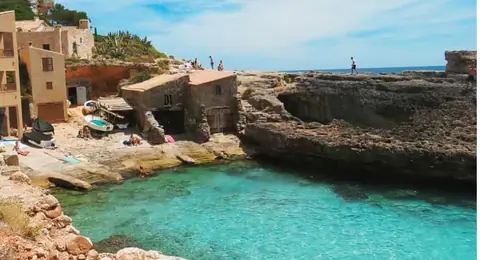
The atmosphere is much more relaxed. It is the locals’ favourite spot for jumping off the rocks, and there is a lovely natural arch (Es Maquer) you can swim under. It is a good place to end the morning and dry off in the sun more peacefully after the busy swim at Caló des Moro.
Best time to visit Caló des Moro and avoid the crowds
The first is an early start. Be at the car park by 8am at the latest. You walk down while it is still cool and find the cove almost deserted. It is the best moment of the day: the water is a mirror and the silence is complete. Around 10am, the crowds arrive in waves.
The second option, riskier but rewarding, is the end of the day, around 6.30pm or 7pm. The light changes and the cliffs turn golden. Bear in mind that, as the cove is enclosed and faces south-east, shade reaches the beach fairly early in the afternoon. You will not have direct sun on the sand any more, but the water stays warm.
What you need to know before you go
To avoid disappointment, keep three things in mind. First, there are no facilities: no bar, no ice-cream seller and, above all, no toilets. Take at least 1.5 litres of water per person.
Second, rubbish. There are no bins on the beach (it is a protected natural area). Everything you bring must go back up with you. Sadly, bottles often end up wedged between the rocks.
Finally, drones. The spot is tempting, but the rules in the Balearics are strict, especially over crowds and protected areas. In Spain, every drone flight follows the rules of AESA, the Spanish aviation safety agency (operator registration, restricted geographical zones): find out before you take off.
Where to eat and drink after the walk
After climbing back up in full sun and walking half an hour in the dust, you will be hungry and thirsty. As there is nothing at the cove, here is how to refuel without driving far for nothing.
If you want to stay nearby, head up to the village of Cala Llombards. There is not much there, but there is the essential. For a local feel, try the small village bar for a cold beer and a “pa amb oli” (bread rubbed with tomato and olive oil). Simple, cheap and restorative.
Ten minutes’ drive away is Santanyí, one of the prettiest villages in the south and the smart option for lunch. On market days (Wednesday and Saturday mornings) it is packed, but on other days it is very pleasant. You can have lunch in one of the village’s restaurants, or simply have an artisan ice cream on the Plaza Mayor and watch the world go by.
Another smart option if you still want the sea but with more comfort: the chiringuito at Cala Llombards, the neighbouring beach. It serves grilled fish with your feet in the sand, with a superb view but without the discomfort of the rocks. It is a good way to end the day and reward yourself after the effort of Caló des Moro.
Is Caló des Moro worth it?
Yes. It is undeniably one of the most beautiful places in the Mediterranean, and the colour of the water alone justifies the trip.
But do not go for a relaxing “beach day” with a book. Go for the view, for a swim in a natural aquarium, and accept the constraints that come with it. If you want comfort and space, head for Es Trenc or Cala Mesquida instead. If you are after raw beauty and happy to walk, go for it, but set your alarm.
FAQ
Where do you park for Caló des Moro?
In the free visitor car park, along the road to Cala Llombards, some way before the cove. In the neighbouring housing estate, spaces are scarce and tightly controlled: fines come quickly and the tow truck is busy in summer.
How long is the walk to Caló des Moro?
25 to 30 minutes: first along the estate road (Carrer des Castellet), then on an earth path with little shade, and finally down a steep rock staircase. It is not suitable for pushchairs or elderly people.
What is the best time to go to Caló des Moro?
Be at the car park by 8am at the latest, before the crowds arrive around 10am. For the turquoise colour, the best window is between 10am and 2pm; in the afternoon, the cliff gradually puts the beach in shade.
Are there any facilities at Caló des Moro?
No: no bar, no toilets and no bins. Take at least 1.5 litres of water per person and carry your rubbish back with you.
Read next
The best beaches in Mallorca: top 10, coves and the wind rule
The best beaches in Mallorca: Es Trenc, Caló des Moro, Cala Pi, Playa de Muro. Access, parking, the wind rule and tips to beat…
Es Trenc beach, Mallorca: parking, access and how to avoid the crowds
Over two kilometres of white sand with no concrete: where to park at Es Trenc (€8 to €10 a day), how to avoid crowds and seaweed…
Cala Varques, Mallorca: how to get there, parking, caves and snorkelling
Cala Varques, a wild cove on Mallorca's east coast: the two paths, where to park since 2026, the sea caves, snorkelling spots and…