Cala Ratjada, Mallorca: things to do, beaches and the walk from the harbour to the lighthouse
12 min readUpdated  By Antoon
Contents
- Arriving in Cala Ratjada
- Cala Rajada or Cala Ratjada: why two names?
- Walking from the harbour to Capdepera lighthouse: 1.8 km to Mallorca’s easternmost point
- Things to do in Cala Ratjada
- Snorkelling in Cala Ratjada: the marine reserve and the coves
- A day in Cala Ratjada
- Cala Ratjada market and the seasons
- Getting to Cala Ratjada by bus or car
- Menorca from Cala Ratjada
- Where to stay in Cala Ratjada: Son Moll, Cala Agulla or Font de sa Cala
- Is Cala Ratjada right for you?
- FAQ
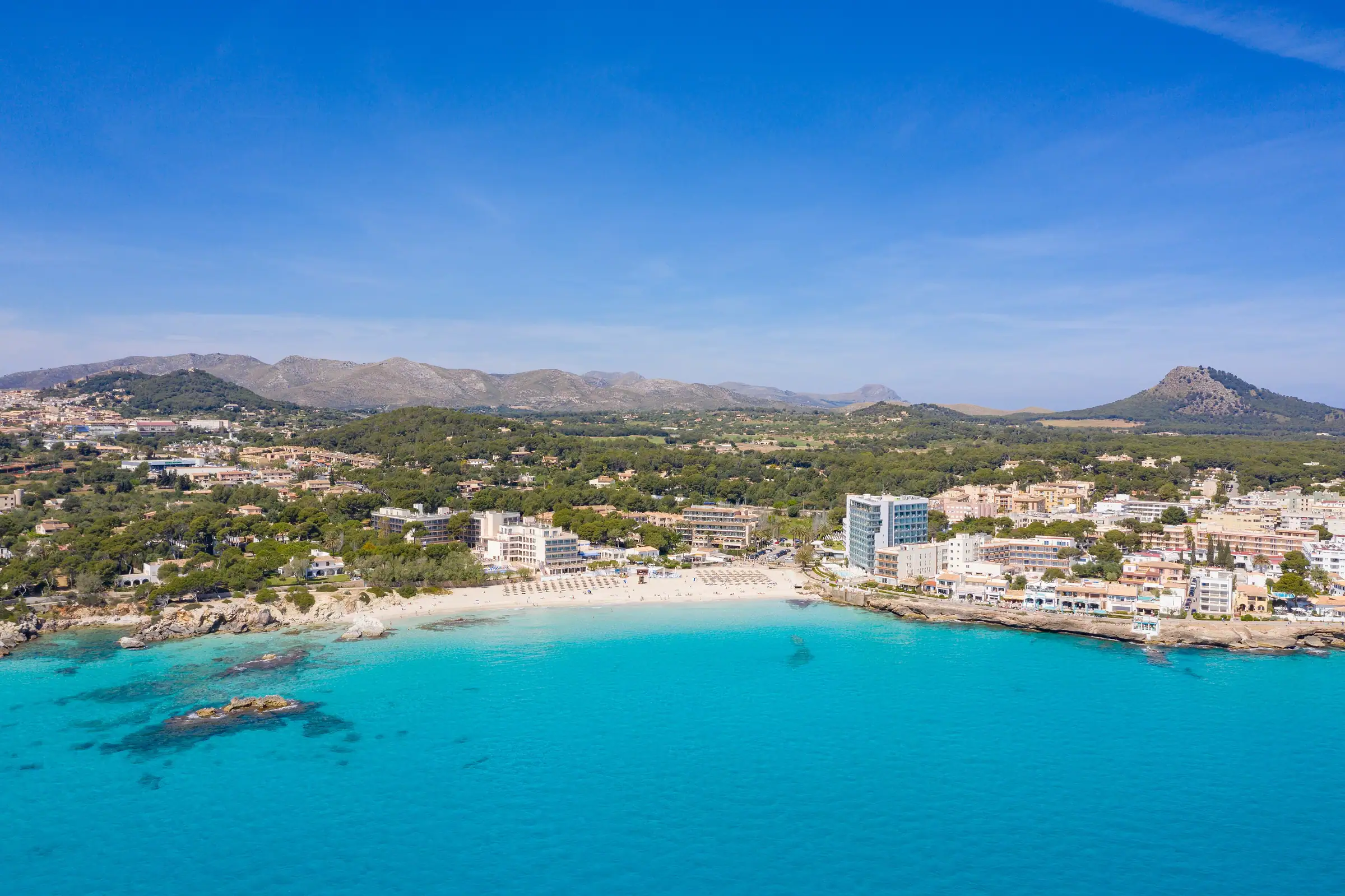
Cala Ratjada is a fishing harbour turned resort at the north-eastern tip of Majorca, 80 km from Palma by road. It belongs to the municipality of Capdepera and sits between the town beach of Son Moll and the long sandy beach of Cala Agulla. From the harbour, a 1.8 km coastal path leads to Capdepera lighthouse, the easternmost point of the island, with Menorca on the horizon 37 km away. The official spelling is Cala Rajada; most visitors, and many local hotels, still write Cala Ratjada.
Arriving in Cala Ratjada
The TIB bus stops at “Cala Rajada centre”, 100 m from Plaça dels Pins, where the tourist office has its usual address. On Saturdays from 8am to 1pm, the market fills the square and Carrer Castellet.
The harbour, 300 m to the east, still keeps its fishing boats. Fishermen asked for a sheltered port as early as 1915, but it was only built in 1944. The Confraria de Pescadors, founded in 1923 at the initiative of the Galician sailor Alfredo Saralegui, was the second fishermen’s guild in the Balearics. In the late afternoon the boats come back in and the nets dry on the quay.
Two promenades run along the sea from the harbour. To the south, the seafront leads to Son Moll beach, 140 m of sand lined with bars and restaurants, then carries on along the Passeig de Ses Pites to Sa Pedruscada. To the north, the streets climb towards Cala Lliteres and Cala Agulla, 1.9 km from Plaça dels Pins.
The village has 7,097 inhabitants (INE 2024), 55% of the municipality of Capdepera, whose old town and castle are 3.4 km inland. Before tourism arrived in the 1960s, Cala Ratjada was just a small fishing port.
Cala Rajada or Cala Ratjada: why two names?
“Rajada” is the Catalan word for the ray, a flat fish once common off this coast: Cala Rajada is “the cove of the ray”. The spelling without the t has been the only official one since a correction in the Balearic Official Bulletin (BOCAIB) of 26 May 1988, which replaced “Cala Ratjada”.
In 1999 a group of residents campaigned, with badges and T-shirts, to keep the t. The Capdepera hoteliers’ association still writes “Cala Ratjada”, as do several hotels in the Consell de Mallorca register, from the BQ Cala Ratjada to the O7 Club Cala Ratjada. “Cala Rayada”, seen in old Spanish texts, is a mistranslation.
Walking from the harbour to Capdepera lighthouse: 1.8 km to Mallorca’s easternmost point
Capdepera lighthouse stands on the easternmost headland of Mallorca. From the harbour, a coastal path passes below the Sa Torre Cega villa and the cove of Cala Gat, then climbs the Carretera del Far: 1.8 km and 25 minutes on foot. In summer, set off early or late in the day.
- The fishermen’s quay (start). Start from the Confraria de Pescadors quay, at the back of the 1944 harbour, and follow the water’s edge eastwards.
- Below the gardens of Sa Torre Cega (450 m, 6 min). The path runs beside the March family villa, designed from 1916 by Guillem Reynés on the site of a watchtower called “cega”, blind, because it could not be seen from any other tower. Its gardens hold most of the 20th-century sculptures of the Bartolomé March Foundation.
- The cove of Cala Gat (900 m, 12 min). The beach measures 50 m by 15 m, below the March villa and sheltered from the tramontana. Yachts anchor offshore, and the islet of Es Faralló is a dive site. There is a snack bar and sunloungers.
- The climb up the Carretera del Far (900 m more). From Cala Gat, the path joins the lighthouse road, which climbs through the pines to the headland. Parking near Cala Gat is difficult: walk from the harbour.
- Capdepera lighthouse (1.8 km, 25 min). Opened on 30 November 1861 to a design by Emili Pou, the lighthouse has an 18 m white tower. Its lantern shines 76 m above the sea, with a range of 20 nautical miles. In 1869 its keepers received the Cross of Charity for rescuing shipwrecked sailors.
- Menorca on the horizon. Together with the Artrutx lighthouse on Menorca, it marks the channel between the two islands at its narrowest, about 37 km. On a clear day, Menorca appears to the north-east. Tradition says that Jaume I waited here in 1231 for his envoys to return: the treaty of Capdepera brought Menorca under his rule.
At night, the lighthouse flashes 2 then 3 times every 20 seconds, visible 20 miles away.
Things to do in Cala Ratjada
The harbour, Sa Torre Cega, Cala Gat and the lighthouse follow one another over 1.8 km. The beaches are less than 2 km from the centre, the castle 3.4 km away.
Cala Ratjada harbour
The 1944 harbour shelters the boats of the Confraria de Pescadors and the excursion boats. In October, the Fira de la Llampuga celebrates the dorado (mahi-mahi), the fish of the autumn.
Sa Torre Cega and the March sculpture gardens
The March family villa was built from 1916 by Guillem Reynés. Its gardens, reworked with the landscape designer Russell Page in the 1960s, display most of the Bartolomé March Foundation’s 20th-century sculptures. Sean Connery filmed “Woman of Straw” (1964) here. Visits are guided only, booked online at least 2 hours ahead, for groups of 6 people or more: Monday to Friday at 10.30am and 12pm, at 9.30am or 10am in July and August, closed at weekends. The address is Carrer Juan March 2.
Cala Ratjada beaches
- Son Moll: the town beach, 140 m by 55 m, with lifeguards and showers, 900 m from Plaça dels Pins. To the south, the Passeig de Ses Pites leads to the pebbly cove of Sa Pedruscada, where boats are pulled up on the shore. Park on Plaça de Son Moll.
- Cala Agulla and Cala Moltó: 520 m of very fine sand among the pines, in a natural area of special interest, with a lifeguard in summer and a zone where naturism is allowed. The rocky cove of Cala Moltó is 50 m away. Cala Agulla is 1.9 km on foot from the centre, about 25 minutes, with a pay car park 100 m from the sand.
- Cala Lliteres: a 30 m by 10 m cove with clear water, 1.4 km from Plaça dels Pins, with the oldest dive school in the area, a bar and a restaurant open in the evening. An 800 m coastal path links it to Cala Agulla.
- Cala Gat: the 50 m sandy cove halfway between the harbour and the lighthouse, sheltered from northerly winds.
- Cala Mesquida: 300 m of beach backed by protected dunes, in the Llevant Peninsula natural park, with a naturist zone. It is 8.4 km away by car, or on bus 422, hourly from late March to October. See our guide to Cala Mesquida.
Capdepera Castle
The walled enclosure was built in the 14th century on the orders of Jaume II as a defence against pirates, and held 125 houses in the 16th century. You walk the ramparts and visit the Gothic chapel of the Esperança, the Torre de sa Boira, the highest point, with a view to Menorca, and the Museu de la Llata, in the Casa del Governador, devoted to dwarf-palm weaving. Entry costs €3. Opening hours: 10am to 5pm from October to March, 10am to 7pm in April, 10am to 8pm from May to September; closed on 25 December and 1 January. Parking is free. The castle is 3.4 km from Cala Ratjada, 6 minutes by car or on bus 411.
The Caves of Artà
At Canyamel, 11.7 km away, the Coves d’Artà are visited on a 35 to 40-minute guided tour. See our guide to Mallorca’s caves.
Snorkelling in Cala Ratjada: the marine reserve and the coves
The coast of Cala Ratjada borders the Llevant de Mallorca marine reserve, created by the Balearic government in 2007: about 4,657 hectares between Cala Mata and Cap des Freus, of which nearly 1,900 hectares are under special protection. At the end of 2007 the Spanish state extended it offshore with a 6,646-hectare reserve.
With mask and snorkel, the rocks of Cala Lliteres, Cala Gat and the small cove of Na Ferradura, between Son Moll and the harbour, are all within walking distance of the centre. The hoteliers’ association also lists the dive sites of Es Faralló, S’Olla and the caves of Cap des Freus. Scuba diving in the reserve requires a permit from the Balearic government, at €5.24 a day. More spots in our guide to snorkelling and diving in Mallorca.
A day in Cala Ratjada
Pick a Saturday for the market, between late March and October for the summer buses.
- 8.30am: the Saturday market, across Plaça dels Pins, Plaça Castellet and the surrounding streets until 1pm.
- 9.30am: the lighthouse walk by Sa Torre Cega and Cala Gat, 1.8 km and 25 minutes each way.
- 11am: swim at Cala Agulla, 25 minutes on foot from Plaça dels Pins.
- 1.30pm: lunch on a terrace by the harbour or along the Son Moll promenade.
- 4pm: Capdepera Castle, 3.4 km by road or on bus 411.
- 6.30pm: Cala Lliteres, linked to Cala Agulla by an 800 m coastal path.
- 8.30pm: the promenade from Son Moll to the harbour, where the restaurants and late-night bars are.
Cala Ratjada market and the seasons
The Cala Ratjada market is on Saturdays from 8am to 1pm on Plaça dels Pins, Plaça Castellet and Carrer Castellet, Méndez Núñez and Bustamante. Capdepera holds its own on Wednesday mornings, on Carrer Centre and Plaça de l’Orient, and a second-hand market fills Plaça Cap Vermell on the second Sunday of the month.
- Spring: summer bus lines 422, 423 and 424 restart on 27 March, line 325 on 1 May. The Fira Medieval takes over Capdepera’s old town and castle for three days in mid-May.
- Summer: 16 July is the feast of the Mare de Déu del Carme, patron saint of sailors. The Sant Roc festivities, from 8 to 16 August, end with fireworks set to music over the harbour. From May to October, craftspeople show their work in the evening on Plaça Castellet.
- Autumn: the Fira de la Llampuga livens up the harbour in October. The summer buses stop on 31 October.
- Winter: on 15, 16 and 17 January, Capdepera celebrates Sant Antoni with demons and bonfires. Bus 411 runs to Manacor 16 times a day from Monday to Saturday, 7 times on Sundays. The castle closes at 5pm.
Getting to Cala Ratjada by bus or car
By car, Cala Ratjada is 80 km from Palma, about 1 hour 15 minutes on the Ma-15, and 82 km from the airport. Capdepera Castle is 6 minutes away, Artà 13 minutes, Porto Cristo 40 minutes. If you are hiring a car, compare offers on our car hire page.
From late March to October, the TIB express 411e links Cala Ratjada with Palma in 1 hour 30 minutes, eight times a day in each direction. In winter, take the 411 to Manacor, then the SFM train or bus 401: only one 411e leaves for Palma, at 5.40am on weekdays. From the airport, the A42 goes to Cala Millor in summer (then change to the 424), the A43 to Manacor in winter (then the 411).
- 411: Cala Ratjada, Capdepera, Artà, Sant Llorenç, Manacor, about 1 hour, roughly every hour.
- 422: Cala Ratjada, Capdepera, Cala Mesquida, 15 to 20 minutes, hourly from 27 March to 31 October.
- 423: Cala Ratjada, Font de sa Cala, Cala Provençals, 20 minutes, hourly from 27 March to 31 October.
- 424: Cala Ratjada, Canyamel, Cala Millor, Porto Cristo, 1 hour 30 minutes to Porto Cristo, every 40 to 45 minutes from 27 March to 31 October.
- 325: Cala Ratjada, Artà, Can Picafort, Alcúdia, 1 hour 10 minutes, hourly from 1 May to 31 October.
Parking: Plaça de Son Moll for the centre, a public pay car park 100 m from Cala Agulla, free parking at Capdepera Castle. Near Cala Gat, come on foot.
Menorca from Cala Ratjada
Regular ferries to Menorca do not leave from Cala Ratjada: Baleària and Menorca Lines sail from Port d’Alcúdia to Ciutadella, in 1 hour to 2 hours 15 minutes. Port d’Alcúdia is 45 km away, 50 minutes by car or 1 hour 10 minutes on bus 325 from May to October. See our page on the ferry between Menorca and Mallorca.
Where to stay in Cala Ratjada: Son Moll, Cala Agulla or Font de sa Cala
The municipality of Capdepera has 78 hotels and 15,528 beds. Son Moll puts the harbour within walking distance, the northern district the beach at Cala Agulla. Font de sa Cala and Cala Mesquida, 3.5 and 8.4 km away, are linked by buses 423 and 422 in summer.
- Son Moll and the centre: for the harbour, the Saturday market and the lighthouse walk on foot, without a car and with evenings on the promenade. The five-star Hotel Serrano Palace is right on the beach, the Son Moll Sentits Hotel & Spa and the Hotel Na Forana a few steps away.
- Cala Agulla and Cala Lliteres: 5 to 10 minutes on foot from both beaches, under the pines, for families and beach days. The Hotel & Spa S’Entrador Playa is on Carrer de l’Agulla, the Mar Azul Pur Estil Hotel & Spa on Carrer de sa Regana Blava, the Protur Turó Pins Hotel & Spa above Cala Lliteres.
- Font de sa Cala and Cala Provençals: 3.5 km south of Son Moll, facing the coves, for a quiet hotel stay with a car or the bus (line 423 reaches Cala Ratjada in 20 minutes in summer). The AluaSoul Carolina is adults only, the Iberostar Waves Pinos Park is on Avinguda Canyamel.
- Cala Mesquida: above the beach and its dunes, 8.4 km from Cala Ratjada, for the beach and the Llevant trails. The Zafiro Cala Mesquida has 357 rooms; bus 422 runs down to Cala Ratjada in 15 to 20 minutes from late March to October.
Is Cala Ratjada right for you?
It suits you if you want to walk to the beach (Son Moll is 900 m from Plaça dels Pins, Cala Agulla 1.9 km), if you snorkel, or if you travel without a car from late March to October, when six TIB lines leave Cala Ratjada. It suits you less if you want to visit Palma every day: the capital is 80 km away, and in winter only one express bus leaves for Palma. Allow half a day for the harbour, Sa Torre Cega and the lighthouse, two to three days with Cala Agulla, Cala Mesquida and Capdepera Castle. Further south, bus 424 serves Cala Millor.
FAQ
Is it Cala Rajada or Cala Ratjada?
The only official spelling is Cala Rajada, without the t, since a correction published in the BOCAIB on 26 May 1988. Cala Ratjada is still widely used and refers to the same village. The name comes from “rajada”, Catalan for the ray.
What is there to do in Cala Ratjada?
Walk the 1.8 km path from the harbour past Sa Torre Cega and Cala Gat to Capdepera lighthouse. Add the beaches of Son Moll and Cala Agulla, snorkelling at Cala Lliteres and Capdepera Castle, 3.4 km away.
What day is Cala Ratjada market?
Saturday, from 8am to 1pm, on Plaça dels Pins, Plaça Castellet and the nearby streets. Capdepera’s market is on Wednesday mornings, and a second-hand market fills Plaça Cap Vermell on the second Sunday of the month.
How do you get from Palma to Cala Ratjada by bus?
From late March to October, the TIB express 411e links Palma with Cala Ratjada in 1 hour 30 minutes, eight times a day. In winter, go to Manacor by SFM train or bus 401, then take the 411, about an hour more.
Can you get to Menorca from Cala Ratjada?
Regular ferries to Ciutadella leave from Port d’Alcúdia, 45 km away, taking 1 hour to 2 hours 15 minutes. From May to October, bus 325 runs there from Cala Ratjada. From Capdepera lighthouse, Menorca is visible on a clear day, 37 km away.
Read next
Things to do in Sóller, Mallorca: the train, the tram, the port and the valley
Things to do in Sóller, Mallorca: train or free tunnel, Sant Bartomeu church, the tram to the port, red prawns and where to park.
Port de Sóller, Mallorca: things to do, the tram, beaches, lighthouses and where to stay
Things to do in Port de Sóller: the 1913 tram from Sóller (30 min, €10), Repic beach, the Cap Gros lighthouse, boats to Sa…
Valldemossa, Mallorca: the Charterhouse, coca de patata and parking
Valldemossa without the crowds: Chopin's Charterhouse (€12.50), coca de patata at Ca'n Molinas, the best viewpoint, the…